

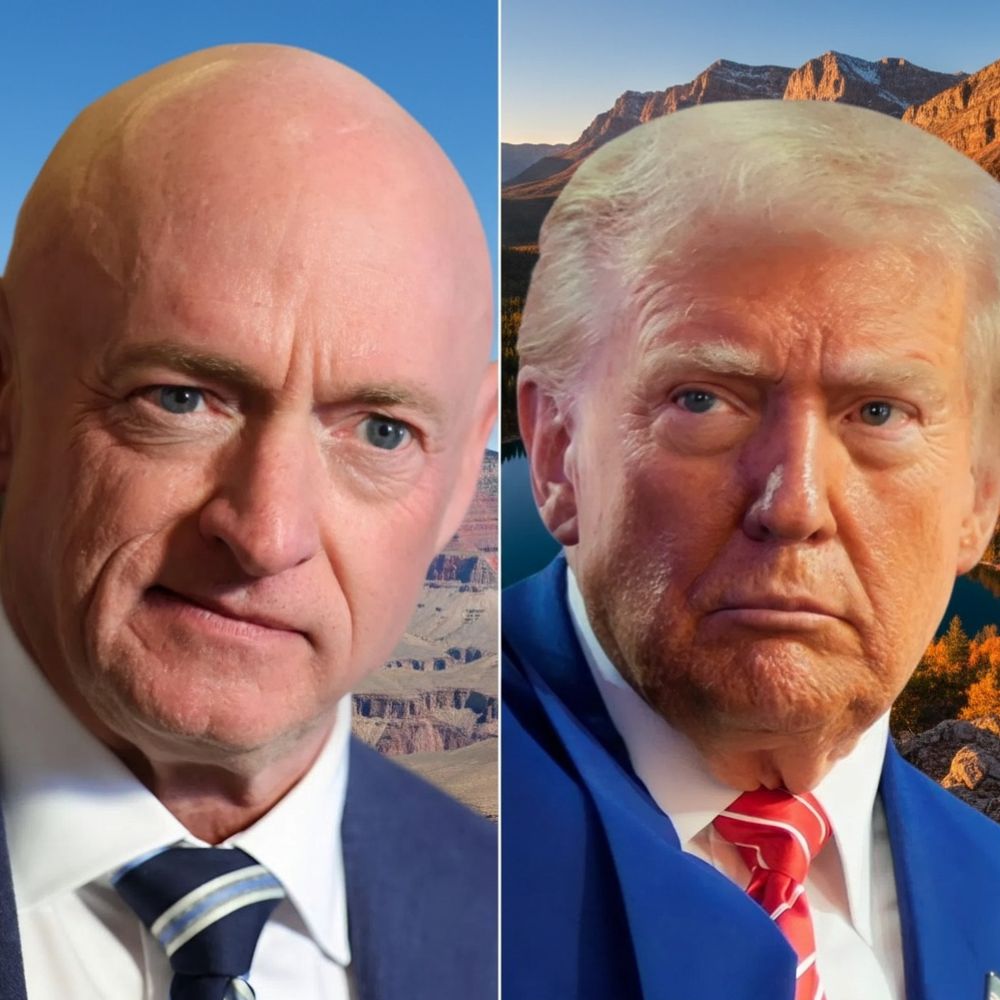
ASTRONAUT SHOOTS DOWN TRUMP: Mark Kelly Says He Was Recovering Fallen Heroes While President Wrote Notes to Epstein
The usually measured tone of Washington, D.C., was violently shattered this week as Senator Mark Kelly, a man whose personal biography reads like a cinematic ode to American service, delivered a searing, high-altitude attack on President Donald Trump. In a press conference that immediately went viral, the Navy combat pilot, lauded NASA astronaut, and Purple Heart recipient—the kind of American hero whose credentials are often only seen on commemorative stamps—unloaded a moral broadside against the President. Kelly’s objective was clear: to establish a categorical difference between his lifetime of high-stakes patriotism and what he presented as Trump’s lifetime of high-profile self-interest and spectacular failures.
This was not a standard political sparring match; it was a devastating contrast built on literal life-and-death experiences, designed to strip away the President’s political armor with the moral authority of someone who has literally stood on the precipice of space. Kelly made it absolutely and unequivocally clear that he is not intimidated, nor will he be “silence[d]” by Trump’s escalating political threats, intimidation attempts, or the calls for his prosecution being amplified by figures like Pete Hegseth.
Kelly began his chronological demolition by reaching back to the President’s pre-political life, juxtaposing a notorious business failure against a harrowing combat tour.
“When Donald Trump was driving the Taj Mahal casino into bankruptcy,” Kelly announced, his voice steady and pointed, “I was getting shot at over Iraq and Kuwait.”
The comparison was a surgical strike: the President was preoccupied with the catastrophic collapse of a gaudy business venture while Kelly was engaged in the deadly, daily grind of kinetic combat operations in the Middle East.
But that was merely the launch sequence. Kelly then piloted the national conversation through a meticulously curated, decade-by-decade tour of Trump’s record of vanity and material pursuits, juxtaposed against Kelly’s continuous, unflinching record of sacrifice, courage, and service to the nation’s deepest commitments.
The 9/11 and Columbia Gut Punches
The Senator moved swiftly to a moment of immense national trauma and sorrow: the destruction of the Twin Towers on September 11, 2001. Here, Kelly’s accusation focused squarely on the President’s capacity for self-aggrandizement during a period of universal grief.
“In 2001, when Trump was bragging that the collapse of the Twin Towers meant he now owned the tallest building in Manhattan,” Kelly revealed, the weight of the historical contrast heavy in the air, “I was carrying flags honoring 9/11 victims into space.”
This comparison perfectly encapsulated Kelly’s critique: while one man sought personal elevation and property dominance from a national tragedy, the other—the astronaut—used the ultimate vantage point of space to honor the fallen, transforming a symbol of scientific achievement into a vessel of national remembrance.
The final, and most devastating, comparison focused on a painful moment in NASA history and a dark episode in Trump’s personal life. In 2003, the Space Shuttle Columbia tragically disintegrated upon re-entry, killing all seven crew members. This disaster, a moment that rocked the nation’s faith in its space program and resulted in the excruciating recovery of human remains, became Kelly’s anchor point for the ultimate moral contrast.
“In 2003, when Trump was writing birthday greetings to Jeffrey Epstein,” Kelly delivered the gut punch, his voice gaining a hard, unyielding edge, “I was recovering the bodies of my friends after the Columbia explosion.”
The contrast was brutal and immediate. One image was that of a man engaged in the painful, solemn duty of collecting the remains of his professional peers—real-life heroes—sacrificed to the pursuit of science and exploration. The other was the President, allegedly engaged in polite correspondence with a convicted sex offender and notorious high-society figure, highlighting an alleged pattern of problematic associations. The specialized terminology of aerospace recovery—recovering fallen astronauts—was wielded not just as a fact, but as a moral indictment of character.
The Cosplay Commander and Real Courage
Kelly’s entire adult life has been defined by stepping directly into danger—whether facing enemy fire as a combat pilot or risking orbital mechanics aboard a volatile spacecraft. He has consistently put himself in the path of the genuine risk that defines real heroism. His opponent, Kelly implied, has never risked anything more dangerous than a spray tan malfunction, a stinging, if slightly frivolous, critique that cuts through the political noise to the core of Trump’s public persona.
The thread of true sacrifice continued to run through the Senator’s narrative. In 2011, while the President was publicly engaging in the highly corrosive, attention-seeking practice of peddling racist conspiracy theories about President Obama, Kelly was facing a different kind of personal, national trauma: holding vigil at his wife Gabby Giffords’ hospital bedside after she survived an assassination attempt.
These moments, spanning decades and disciplines—from combat aviation and astronautics to coping with domestic terrorism—form the bedrock of Kelly’s moral defense. They are the credentials that Kelly believes render the President’s current political threats completely impotent.
“My point is this,” Kelly stated, pivoting the focus from the historical critique to the present, “I’ve been through a lot worse in service to my country. The president and Pete Hegseth are not going to silence me.”
The reference to Pete Hegseth as Trump’s cosplay–commander sidekick further sought to diminish the gravity of the President’s political threats by wrapping them in ridicule, suggesting that Trump, hiding behind a podium, is a man who folds under pressure faster than one of his casinos. Kelly made it clear that he will not be intimidated by a political strongman whose reputation, in Kelly’s estimation, is built on vanity, bluster, and business failures rather than genuine grit.
This press conference was far more than a political retort; it was a full-force reminder of what real, visceral, and unfeigned courage looks like in the public arena. Mark Kelly stood his ground not with political talking points, but with the moral weight of his lifetime accomplishments. He showed the country exactly why the President and his allies are trying so desperately to shut him up—because the truth, especially when spoken by someone who’s actually lived it, poses the most existential threat to their manufactured narrative of strength. The ultimate showdown between political celebrity and genuine hero has now been launched, and the nation waits for the President’s response.