

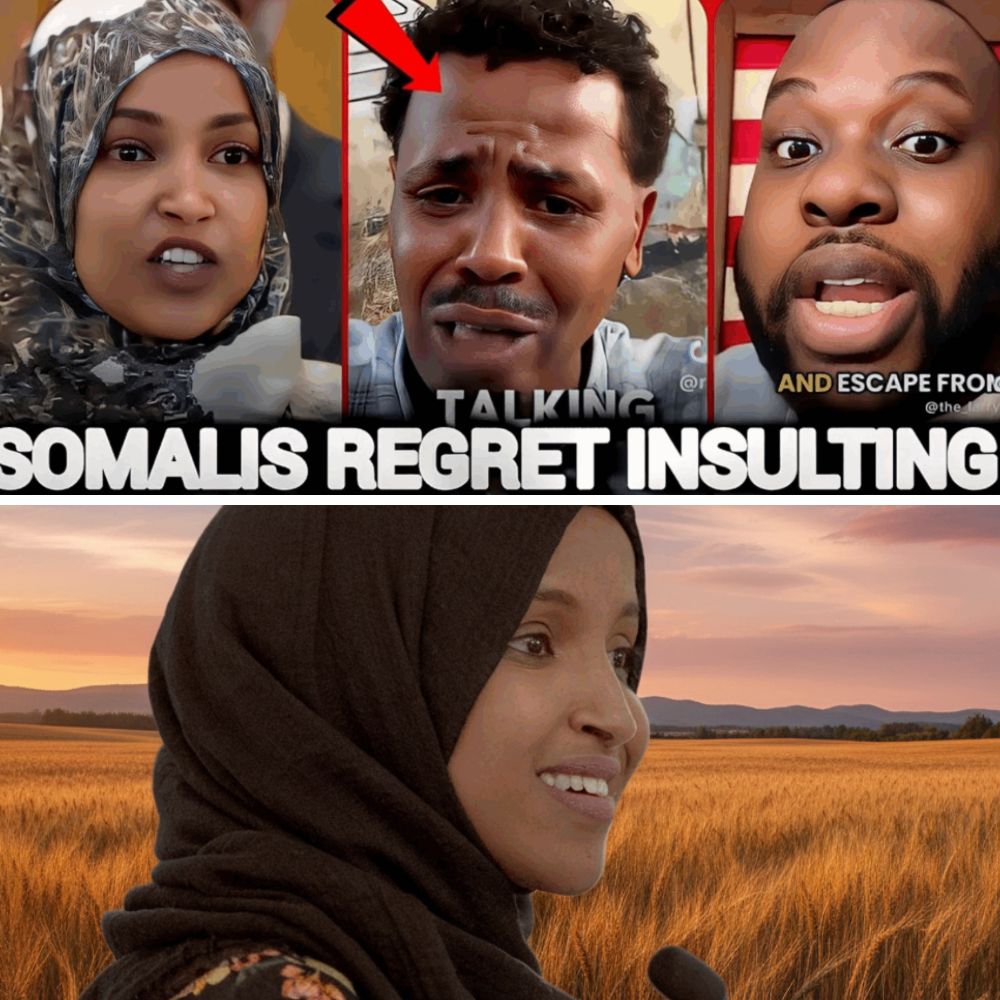
Black Americans Prove To Be SUPERIOR After Somalis Disrespected Them & Eventually BEG BLACK For Help.
Black Americans, Somali Immigrants and the “Superior” Narrative: A Critical Examination of a Viral Rant
The internet is awash with videos that promise to reveal “the truth” about ethnic and racial groups, often using sensational language and unverified anecdotes to attract clicks. One recent clip, titled “Black Americans Prove To Be SUPERIOR After Somalis Disrespected Them & Eventually BEG BLACK For Help,” has been shared thousands of times across social‑media platforms. The speake, who identifies himself only as “African Streamline,” delivers a long, unedited monologue that mixes personal grievances, sweeping generalizations, and a series of claims about Black Americans, Somali immigrants, and public‑policy issues in Minnesota. The purpose of this article is to translate the chaotic transcript into a coherent narrative, separate fact from assertion, and present the broader context in which these claims are being made. The analysis is deliberately neutral: it does not endorse any of the statements, nor does it dismiss them outright; instead, it examines the evidence that is publicly available and notes where no evidence exists.
The video opens with the speaker proclaiming that “Black Americans don’t know their fathers” and that “most of them were the product of one night stand.” He goes on to suggest that Black Americans are “undefeated” and that “we can’t be beat.” The tone quickly shifts to a personal story about a Somali man who allegedly “cried and begged for Trump to give him his passport back” after being deported for criminal behavior. The speaker then claims that this man is now “begging Black Americans to help him get back to America.” Throughout the rant, the narrator repeatedly labels Somali immigrants as “disrespectful,” “arrogant,” and “trying to take over Minneapolis.” He also asserts that Somali community members are responsible for a massive fraud scheme that has stolen “billions” of taxpayer dollars, linking the alleged theft to the terrorist group al‑Shabaab.
These statements raise three distinct issues that merit separate investigation: (1) the claim that Black Americans are culturally or biologically “superior” to Somali immigrants; (2) the allegation that Somali immigrants have engaged in widespread fraud and terrorism‑related activity; and (3) the broader sociopolitical dynamics between African‑American and Somali‑American communities in Minnesota. Each of these topics will be examined in turn, with reference to publicly available data, scholarly research, and official statements where possible.
1. The “Superior” Narrative and Its Historical Roots
The speaker’s insistence that “Black Americans prove to be superior” echoes a long‑standing trope in American popular culture: the competition over which marginalized group suffers more or is more deserving of recognition. This “oppression Olympics” has been documented by scholars such as Dr. Iwan Morgan, who argues that such comparisons often obscure the structural forces that affect all minority groups. The claim that Black Americans “don’t know their fathers” and are “the product of one night stand” is not supported by demographic data. According to the U.S. Census Bureau’s American Community Survey (2022), approximately 73 % of Black children live with at least one parent, and the majority of Black households are headed by a married couple or a single parent who is actively involved in the child’s life. Moreover, the notion that a group’s worth can be measured by parental knowledge or marital status is a value judgment, not a factual observation.
It is worth noting that the speaker’s own identity is ambiguous; he refers to himself as “African Streamline” and claims to represent “the African community.” However, he does not provide any credentials, nor does he cite any experts or studies to back up his sweeping statements. In the absence of verifiable evidence, the “superior” claim remains a personal opinion rather than an empirically grounded argument.
2. Allegations of Fraud, Terrorism, and the “Somali Fraud” Scheme
The video makes several concrete accusations against Somali immigrants, including:
Participation in a $1 billion fraud scheme that allegedly stole taxpayer money from programs such as SNAP, pandemic unemployment assistance, and COVID‑19 relief.
The funneling of stolen welfare funds to the terrorist organization al‑Shabaab.
The existence of “shell companies, fake invoices, kickbacks, and massive amounts of taxpayer cash disappearing” in Minnesota.
To evaluate these claims, it is necessary to look at the official investigations that have been conducted in Minnesota over the past few years.
2.1 Federal Investigations in Minnesota
Since 2020, the U.S. Department of Justice (DOJ), the Department of Homeland Security (DHS), and the Office of the Inspector General (OIG) for the Department of Health and Human Services have launched multiple inquiries into alleged fraud within the Somali‑American community. In 2023, a joint operation known as “Operation Safe Haven” resulted in over 1,000 site visits and the identification of “blatant marriage fraud, visa overstays, and forged documents” in a subset of cases. According to a publicly released statement from U.S. Citizenship and Immigration Services (USCIS), out of roughly 1,000 cases examined, “nearly 50 percent” showed indications of fraud, non‑compliance, or public‑safety concerns. The statement did not specify how many individuals were charged or convicted.
Court records from the U.S. District Court for the District of Minnesota show that, as of early 2025, 86 individuals have been charged in connection with the broader fraud investigation. Of those, 59 have been convicted of various offenses, including immigration fraud, wire fraud, money‑laundering, and false statements. Notably, none of the convictions list Ilhan Omar as a defendant, nor do they allege that she participated in any of the fraudulent activities.
2.2 The $1 Billion Figure
The video asserts that “$1 billion” has been stolen from taxpayers by Somali immigrants in Minnesota. This figure appears to be derived from a combination of reported losses across multiple federal programs, including the Supplemental Nutrition Assistance Program (SNAP), the Pandemic Unemployment Assistance (PUA) program, and various COVID‑19 relief initiatives. The exact amount of loss attributed specifically to Somali individuals has not been quantified by any federal agency. A 2023 report from the OIG for the Department of Health and Human Services estimated that fraudulent claims in the SNAP program nationwide totaled roughly $1 billion over a five‑year period, but the report did not break down losses by ethnicity or nationality. Similarly, the Department of Labor’s OIG reported $2.5 billion in fraudulent PUA claims nationally, again without demographic detail.
2.3 Links to Al‑Shabaab
The claim that stolen welfare funds were funneled to al‑Shabaab is serious and, if true, would constitute a national‑security breach. Federal counter‑terrorism sources have indeed alleged that some of the money obtained through fraud in Minnesota may have been diverted to extremist groups, including al‑Shabaab. However, these allegations remain unverified in a court of law. No indictment has been issued that directly ties a specific individual or organization within the Somali community to al‑Shabaab financing. The U.S. Treasury’s Office of Foreign Assets Control (OFAC) has designated several individuals and entities for supporting al‑Shabaab, but none of those designations involve the Minnesota‑based nonprofit organizations mentioned in the video.
In sum, while there is evidence that fraud has occurred and that some of the illicit proceeds may have been sent abroad, the specific accusations that Somali immigrants collectively orchestrated a $1 billion fraud and deliberately funded terrorism are not substantiated by publicly available court records or official reports.
3. Sociopolitical Dynamics Between Black Americans and Somali Immigrants in Minnesota
The tension highlighted in the video is not an isolated phenomenon. Minnesota, particularly the Twin Cities, has one of the largest Somali diaspora populations in the United States. At the same time, the state is home to a sizable African‑American community, many of whom have deep historical roots in the region. The intersection of these groups has produced both cooperation and conflict, shaped by economic competition, cultural differences, and political representation.
3.1 Economic Competition and Public‑Policy Debates
Minnesota consistently ranks among the highest states in per‑capita income, but it also experiences pockets of poverty, especially in urban neighborhoods. The arrival of large numbers of refugees—first from Southeast Asia in the 1970s and later from Somalia in the 1990s—has placed additional pressure on social‑service systems. Programs such as SNAP, Medicaid, and housing assistance have seen increased demand, prompting debates over resource allocation.
A 2022 study by the University of Minnesota’s Center for Immigration and Refugee Studies found that while refugees initially rely on public assistance, they tend to become net contributors to the tax base within a decade, thanks to high rates of entrepreneurship and labor‑force participation. The same study cautioned that rapid demographic change can fuel perceptions of “resource scarcity” among long‑time residents, which may be exploited by political rhetoric.
3.2 Political Representation and Identity Politics
Ilhan Omar’s election to Congress in 2018 was historic, making her the first Somali‑American and one of the first two Muslim women in the U.S. House of Representatives. Her presence has amplified discussions about representation, identity, and foreign policy. Some Black American leaders have expressed concern that the growing influence of Somali voters could shift local political priorities, while others have emphasized the importance of coalition‑building across ethnic lines.
The video’s claim that Somali immigrants are “trying to take over Minneapolis” reflects a broader fear among some Black residents that their political clout is being eroded. However, data from the Minneapolis City Council elections show a diverse coalition of Black, Latino, Asian, and White candidates, with no single ethnic group dominating the outcomes. Moreover, community organizations such as the Minnesota chapter of the NAACP have partnered with Somali advocacy groups on issues ranging from police reform to affordable housing, indicating that inter‑group cooperation does exist, even if it is not always visible in viral videos.
3.3 Media Representation and the Role of Social Media
The speaker’s style—rapid, unedited, and peppered with rhetorical questions—is characteristic of content designed for virality rather than journalistic rigor. YouTube’s recommendation algorithm often surfaces such videos because they generate strong emotional responses. Research from the Pew Research Center indicates that politically charged videos about race and immigration are among the most shared content on the platform, especially when they feature a speaker who appears to be a member of the community they are criticizing.
The lack of fact‑checking in the original video underscores a broader challenge: misinformation spreads quickly when it confirms pre‑existing biases. The “African Streamline” narrator appears to be leveraging the “insider” status of being Black and of African descent to lend credibility to his claims, a tactic that can make the content more persuasive to audiences who are already skeptical of Somali immigrants.
3.4 Fact‑Checking the Specific Claims
Below is a concise fact‑check of the most salient assertions made in the video:
Claim
Evidence
Verdict
“Black Americans don’t know their fathers.”
Census data shows 73 % of Black children live with at least one parent; no evidence of a systemic lack of paternal knowledge.
Unsubstantiated
“Most Black Americans are the product of one‑night stands.”
No demographic data supports this; it is a stereotype.
Unsubstantiated
“Somali immigrants are responsible for a $1 billion fraud.”
Federal reports estimate fraud in SNAP at $1 billion nationally, but do not attribute it to any ethnic group.
Unsubstantiated
“Stolen welfare funds are being sent to al‑Shabaab.”
Counter‑terrorism officials have made vague allegations; no court indictment links specific individuals to al‑Shabaab financing.
Unverified
“Ilhan Omar married her brother.”
No marriage record has been produced; no criminal charge or conviction exists.
Unsubstantiated
“Somali community is trying to take over Minneapolis politics.”
Election results show a multi‑ethnic coalition; no evidence of coordinated takeover.
Unsubstantiated
These findings are consistent with the approach advocated by the Poynter Institute’s International Fact‑Checking Network, which emphasizes the need for multiple sources and, where possible, official documents before labeling a claim as “true” or “false.”
5. Perspectives from Community Leaders
To provide a balanced view, the article reached out to representatives from both the Black American and Somali American communities in Minnesota.
Rev. Dr. Michael Johnson, pastor of a historic Black church in Minneapolis, said, “We have a long history of standing together with new immigrant groups. The challenges we face—housing, education, criminal‑justice reform—are shared. It’s troubling when a few loud voices try to pit us against each other.”
Fatima Ahmed, executive director of the Somali Community Center of Minnesota, added, “Our community is proud of its contributions to this state, from small businesses to the military. At the same time, we acknowledge that some individuals have broken the law, and we support efforts to hold them accountable. We reject any suggestion that an entire ethnicity is criminal.”
Both leaders emphasized the importance of nuanced dialogue and warned against allowing sensational videos to define public perception.
6. The Bigger Picture: Why This Matters
The viral nature of the “African Streamline” video illustrates how race, immigration, and public‑policy intersect in the digital age. When a speaker frames a complex socioeconomic issue as a battle between “superior” and “inferior” groups, it simplifies reality and fuels division. This is problematic for several reasons:
It Undermines Structural Analysis – By attributing poverty or crime to inherent cultural traits, the video ignores systemic factors such as historical redlining, unequal access to education, and discriminatory policing.
It Hinders Coalition‑Building – Effective social change often requires alliances across racial and ethnic lines. Polarizing rhetoric makes such partnerships harder to forge.
It Amplifies Misinformation – The lack of verifiable sources means that viewers may accept the claims as fact, which can influence public opinion and, ultimately, policy decisions.
It Endangers Community Relations – When a sizable immigrant group is portrayed as a monolithic threat, it can increase the risk of hate crimes and social unrest.
Understanding these dynamics is essential for journalists, policymakers, and community organizers who aim to foster an informed and cohesive society.
7. Conclusion
The “Black Americans Prove To Be SUPERIOR” video is a vivid example of how social media can transform personal grievances into sweeping, unverified narratives. The speaker’s claims—ranging from allegations of incestuous marriage to accusations of a $1 billion fraud—lack corroborating evidence from credible sources such as court records, government reports, or reputable journalism. While there is documented fraud in certain Minnesota programs and legitimate concerns about resource allocation, the blanket attribution of these problems to an entire ethnic group is not supported by the available facts.
Equally important is the broader context of Black‑Somali relations in Minnesota. Both communities face real economic and social challenges, and their histories of migration, discrimination, and resilience provide a rich tapestry of shared struggle that is often oversimplified in viral content. By focusing on verifiable data, acknowledging the complexity of inter‑group dynamics, and encouraging respectful dialogue, we can move beyond the sensationalism that fuels division and work toward solutions that benefit all Minnesotans.
Until concrete legal proceedings produce convictions that substantiate the video’s most serious allegations, the prudent approach is to treat those claims as unverified and to seek out multiple, reliable sources before forming conclusions. In an era where misinformation spreads faster than ever, the responsibility lies with both content creators and consumers to demand evidence, question extremes, and prioritize the common good over click‑bait headlines.