

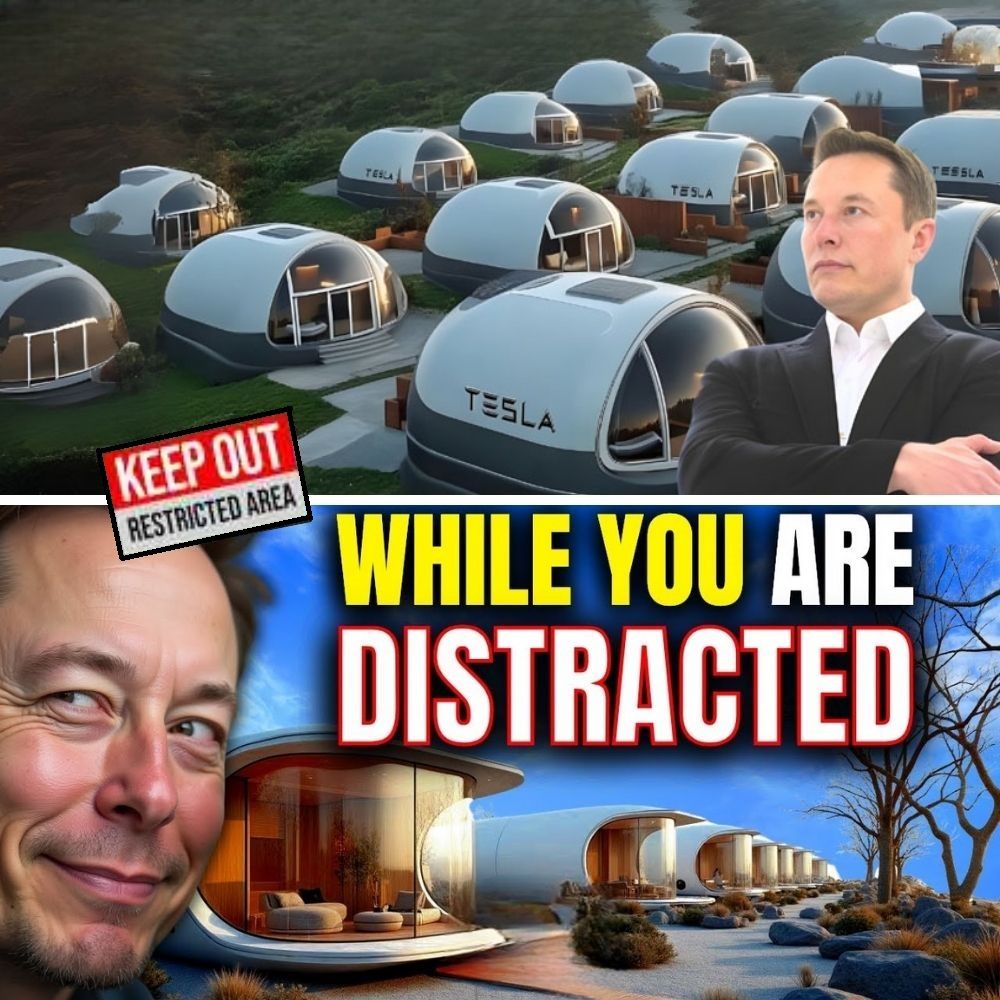
A swirl of rumors, leaked photos, and anonymous claims has pushed the internet into another frenzy over Elon Musk — this time surrounding allegations that the billionaire is quietly constructing a mysterious “worker city” somewhere in Texas.
The speculation erupted after a handful of low-resolution images began circulating online, allegedly showing fenced-off construction zones, uniform modular housing units, and infrastructure layouts resembling an isolated micro-town. None of the images have been authenticated, yet they have triggered a wave of intense public discussion.
Critics describe the rumored project as a “modern slave city,” claiming Musk may be developing a tightly controlled community where employees live, work, and spend their income entirely within a Musk-owned ecosystem. They argue the model could give corporations unprecedented control over workers’ lives, echoing historical “company towns” that have long been criticized for exploitative practices.
Supporters, however, dismiss the allegations as exaggerated or politically motivated, insisting the project — if real — is likely an advanced technological hub designed to solve housing shortages for workers at Tesla, SpaceX, or The Boring Company. They frame it as a bold experiment: a self-sustaining community powered by renewable energy, advanced automation, and groundbreaking urban-design principles.
At the center of the speculation is Musk’s well-known ambition to reshape human living environments, from Mars habitats to high-density smart cities on Earth. The lack of official clarification from Tesla or SpaceX has only deepened the mystery, allowing theories — both hopeful and dystopian — to flourish across social media.
Some commentators believe the rumors stem from early plans for “Snailbrook,” a real Musk-affiliated town under development near Austin, which aims to provide affordable housing for employees. They argue online speculation has distorted facts into dramatic narratives of surveillance, restriction, and corporate dominance.
Others insist the leaked images depict something far more secretive, pointing to unusual architectural layouts, high-security perimeters, and zone markers that appear inconsistent with ordinary commercial development. Without verification, the line between fact and fiction remains blurry.
Labor-rights advocates have stepped into the conversation as well, warning that company-owned housing arrangements can easily become coercive, limiting worker mobility and increasing economic dependency in ways that undermine freedom and bargaining power.
Meanwhile, economists suggest that if Musk is indeed building a dedicated worker community, it could represent a major shift in how tech giants structure workforce ecosystems — blending housing, transportation, energy, and employment into a single centralized model.
Despite the heated debate, one truth remains: Musk has not publicly addressed the leaked rumors, nor have any of his companies provided comment or clarification. In the absence of official information, speculation continues to fill the vacuum.
Whether the mysterious development is a technological breakthrough, a misinterpreted construction site, or a controversial experiment in corporate urban planning, it has already ignited global discussion about labor ethics, corporate influence, and the future of worker autonomy.
Until Musk breaks his silence, the world is left to wrestle with the question:
Is this the dawn of a revolutionary new model for workforce living — or the beginning of a troubling new era of corporate control?
Local officials in several Texas counties have also begun quietly distancing themselves from the conversation, claiming they have no knowledge of any large-scale private city in development, even as satellite imagery shows ongoing land acquisition and infrastructure grading linked to Musk-affiliated companies.
This secrecy has only intensified public speculation, especially after online investigators pointed out that multiple LLCs tied to Musk have purchased unusually large tracts of land over the past two years, often through shell corporations designed to obscure ownership.
Urban-planning experts argue that if Musk truly intends to build a new kind of worker community, the project would likely represent a hybrid model—part residential hub, part innovation district, and part experimental social ecosystem designed around automation and sustainability.
They note that Musk has repeatedly expressed dissatisfaction with traditional city planning, calling many American cities “deeply inefficient,” “structurally outdated,” and “incapable of supporting the workforce of the future,” statements that could hint at deeper ambitions extending far beyond housing.
Some analysts believe Musk’s rumored project may be part of a broader vision to test the boundaries of private governance, exploring how far a corporation can go in designing and controlling an urban environment while still complying with state and federal law.
They argue that a self-contained community would allow Musk to bypass slow regulatory processes, test renewable energy systems at scale, and integrate AI-driven infrastructure without battling entrenched political resistance or zoning restrictions found in major metropolitan areas.
However, critics fear this freedom could come at a steep price for residents, raising questions about autonomy, surveillance, labor rights, and the long-term implications of living inside a community where one company controls employment, utilities, housing, and transportation simultaneously.
Concerns escalated further when reports emerged suggesting that some Musk-run companies have explored tying housing access to employment status, a practice reminiscent of early 20th-century industrial towns that trapped workers economically and socially.
Labor advocates warn that if such a system were implemented on a modern scale, it could lead to unprecedented levels of worker dependency, with employees potentially losing their homes if they were dismissed or disagreed with management decisions.
Tech ethicists emphasize that the real question is not whether Musk intends to exploit workers, but whether any corporation should possess the power to design entire communities without democratic oversight, especially when those communities house vulnerable workers.
Meanwhile, Musk supporters argue that centralized living may actually improve quality of life, offering affordable housing, reduced commuting time, clean energy, and access to cutting-edge technology unavailable in traditional cities bound by bureaucracy.
They claim that fears of exploitation stem from outdated narratives and a misunderstanding of Musk’s broader mission to create efficient, sustainable, high-tech environments aligned with the needs of future generations rather than legacy government systems.
Nevertheless, leaked documents—of uncertain authenticity—suggest the project may involve tiered living zones, biometric security integration, and AI-driven monitoring systems that critics say could infringe on privacy or consolidate unprecedented corporate control over daily life.
While none of these documents have been confirmed, their existence highlights the growing distrust between the public and large tech corporations, especially those with expanding influence over transportation, energy, communication, and soon potentially housing.
Sociologists observing the debate warn that public reactions reveal deeper anxieties about the privatization of civil life, reflecting fears that tech billionaires may increasingly shape society not just through products, but through physical environments and governance structures.
They argue that if corporations begin controlling cities, traditional democratic mechanisms may weaken, pushing citizens into systems where participation is optional, rights become contractual, and community values are shaped by market interests rather than collective consensus.
Economists see potential benefits as well as risks, noting that rapid urbanization and housing shortages require bold experimentation, and corporations may be better equipped than governments to build innovative infrastructure quickly and cost-effectively.
Yet they caution that such experiments must include safeguards, transparency, and public accountability, ensuring that efficiency does not overshadow human dignity or workers’ fundamental rights.
The controversy intensified when activists released drone footage allegedly showing grid-pattern structures resembling residential units on land tied to Musk-related enterprises, though experts caution that the footage could depict standard industrial development unrelated to any private city.
Despite the ambiguity, the imagery sparked renewed outrage, with critics arguing that Musk’s silence is itself a strategic communication tool designed to generate mystique, avoid regulation, or test public reaction before making an official declaration.
Political commentators suggest the federal government may already be aware of the project and is choosing not to intervene, either due to economic incentives, strategic partnerships, or an unwillingness to challenge a billionaire with enormous political and cultural influence.
Texas officials, known for welcoming large corporate operations, may also view the rumored city as a major economic catalyst, potentially transforming rural regions into powerful innovation clusters connected to Tesla’s and SpaceX’s expanding presence.
Meanwhile, community groups in surrounding counties express fear that a Musk-controlled hub could drive up land prices, displace local residents, alter demographic landscapes, and create economic imbalances that reshape the region without public consent.
Some warn that private cities risk becoming “digital plantations,” where workers live comfortably but remain tightly integrated into systems designed around corporate efficiency rather than personal freedom or long-term community welfare.
Others argue that if Musk succeeds, the project could become a template for future cities worldwide—dense, electric, AI-driven, sustainable, and optimized for human productivity while minimizing environmental impact.
The polarized debate reflects a society torn between fascination with innovation and fear of losing autonomy, a tension amplified whenever Musk introduces new technology or hints at reshaping fundamental aspects of modern life.
Journalists are now pressing Musk for comment, but so far he has declined to address the rumors directly, posting only cryptic remarks on social media that do little to clarify his intentions or dispel public apprehension.
One such post reads, “Cities must evolve,” which supporters interpret as a visionary statement, while critics see it as a subtle confirmation that Musk is indeed preparing something transformative, disruptive, and potentially controversial.
Until Musk or his companies make a formal announcement, the world remains suspended between reality and rumor, caught in a haze of speculation that grows thicker with each new leak, satellite image, and anonymous testimony.
What began as a handful of blurry photos has now become a global debate about corporate power, human rights, innovation, and the meaning of freedom in a future where cities might be designed not by governments, but by billionaires with boundless ambition.
And perhaps the most unsettling question remains unanswered: If Musk truly is building a new kind of city… who will it ultimately serve — the workers inside it, or the empire surrounding it?