

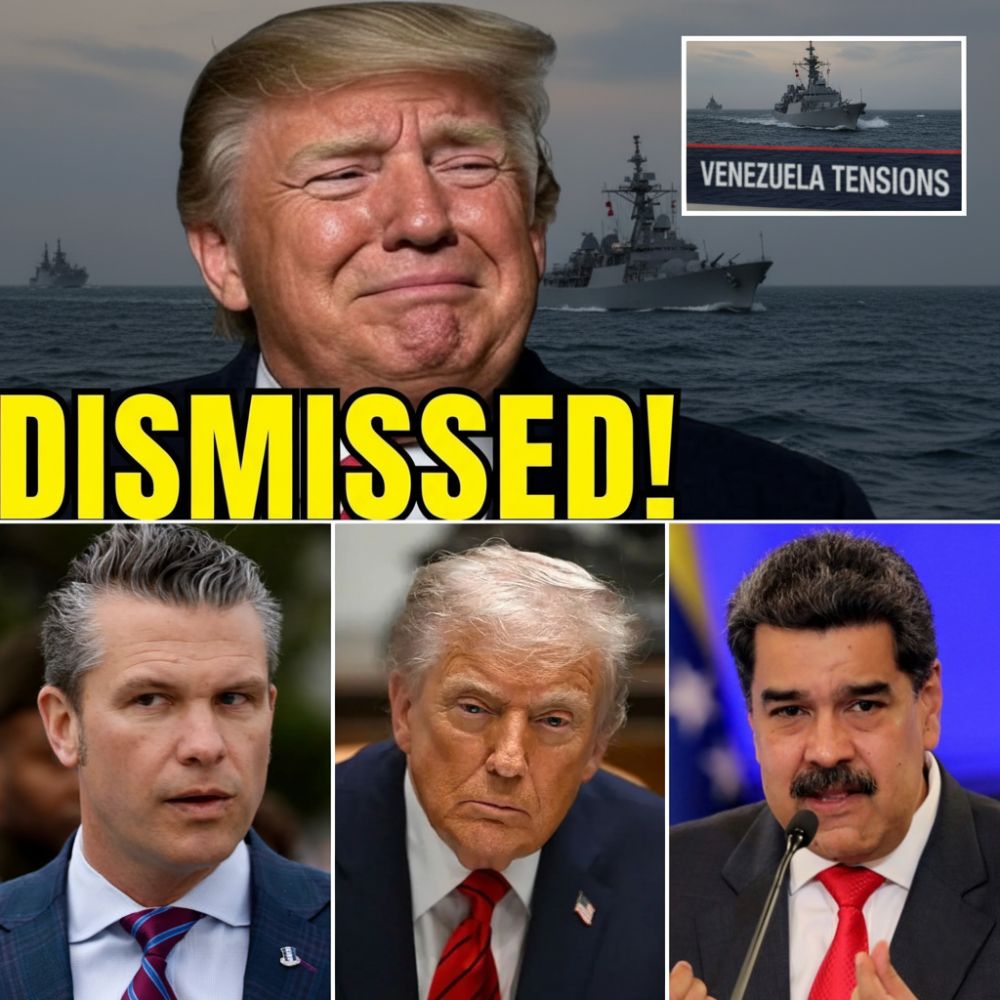
WASHINGTON — What began as a murky dispute over military strikes and maritime seizures has escalated into one of the most explosive legal and political confrontations of the T.r.u.m.p era, as the Supreme Court is now thrust into the center of a controversy involving an oil tanker seized off Venezuela’s coast, questions of presidential authority, and allegations that stretch from constitutional violations to outright piracy.
According to multiple officials and legal analysts, the Court’s intervention — forcing the return of a tanker allegedly seized under the direction of the White House — has intensified scrutiny of T.r.u.m.p’s broader strategy in the Western Hemisphere. Republicans on Capitol Hill, once reliable defenders, are showing visible signs of strain. Several lawmakers privately describe shifting explanations from the administration as “exhausting” and increasingly difficult to defend in public.
At the heart of the controversy are recent U.S. strikes and naval actions near Venezuela, including the destruction of vessels and the seizure of oil assets. From the very first strike, lawmakers and legal experts questioned the legality of the operations. Those concerns have only grown louder as intelligence justifications remain classified and congressional briefings yield sharply divided reactions.
Pressure is now landing squarely on Defense Secretary Pete Hegseth, as well as the administration’s legal team. An admiral overseeing regional operations quietly stepped aside in recent days, a move that, while officially unexplained, coincided with escalating military actions and renewed scrutiny from Congress.
To understand why Venezuela sits at the center of this storm, administration officials point to cold economic realities. The country holds an estimated 17 percent of the world’s known oil reserves, along with vast, largely untapped rare-earth minerals critical to modern technology. In interviews, senior officials describe Venezuela as a “cash cow” — a potential windfall for U.S. business interests, if political obstacles can be removed.
That calculation is embedded in what advisers call the “T.r.u.m.p corollary” to the Monroe Doctrine. While the original 19th-century doctrine warned European powers to stay out of the Western Hemisphere, the modern version, critics argue, asserts U.S. dominance outright. The administration’s newly released national security strategy emphasizes reducing competition with China by consolidating American influence closer to home — economically, politically, and militarily.
Yet even within the administration, sharp disagreements persist. Must President Nicolás Maduro remain in power for U.S. companies to operate, or must he go? That unresolved question has fueled weeks of internal debate and, critics say, reckless external action.
Publicly, T.r.u.m.p has long framed Maduro as a brutal dictator. In a 2017 speech, he accused Venezuela’s government of inflicting “terrible misery” and warned of further U.S. action. Today, those warnings have materialized into explosions at sea — actions many analysts view as precursors to possible land-based operations.
What has alarmed observers further is the president’s apparent distance from operational details. In recent remarks, T.r.u.m.p claimed he was unaware of a second strike and deferred responsibility to Hegseth, raising questions about command, oversight, and accountability.
Legal experts describe the administration’s justifications as deeply troubling. They argue that national security lawyers appear to be shaping facts to fit predetermined conclusions, rather than advising restraint. Even more controversial is the reported decision to repatriate surviving targets rather than bring them into U.S. custody — a move critics say is designed to avoid judicial scrutiny and due process.
Adding fuel to the fire is the background of the Office of Legal Counsel official who approved key memos. At just 36 years old, with no prior federal experience, he previously worked on efforts to overturn the 2020 election — a résumé critics say raises profound concerns about independence and competence.
For many observers, the administration’s refusal to release full video footage is telling. Graphic images of survivors clinging to wreckage, they argue, could echo past scandals like Abu Ghraib — moments when visuals shattered official narratives and reshaped public opinion overnight.
To critics, the tanker seizure is not merely a legal misstep but a defining scandal. They argue it violates international law, undermines congressional authority, and endangers U.S. troops while projecting an image of America as a rogue actor rather than a guardian of democratic norms.
“This isn’t a team sport,” one analyst warned. “When a government crosses into lawlessness, citizens are obligated to push back.”
As the Supreme Court weighs its role and Congress debates its next move, one reality is clear: this confrontation has cracked open fundamental questions about presidential power, accountability, and America’s place in the world — and the fallout is spreading at digital speed, timelines are melting down, and the internet is absolutely exploding.