

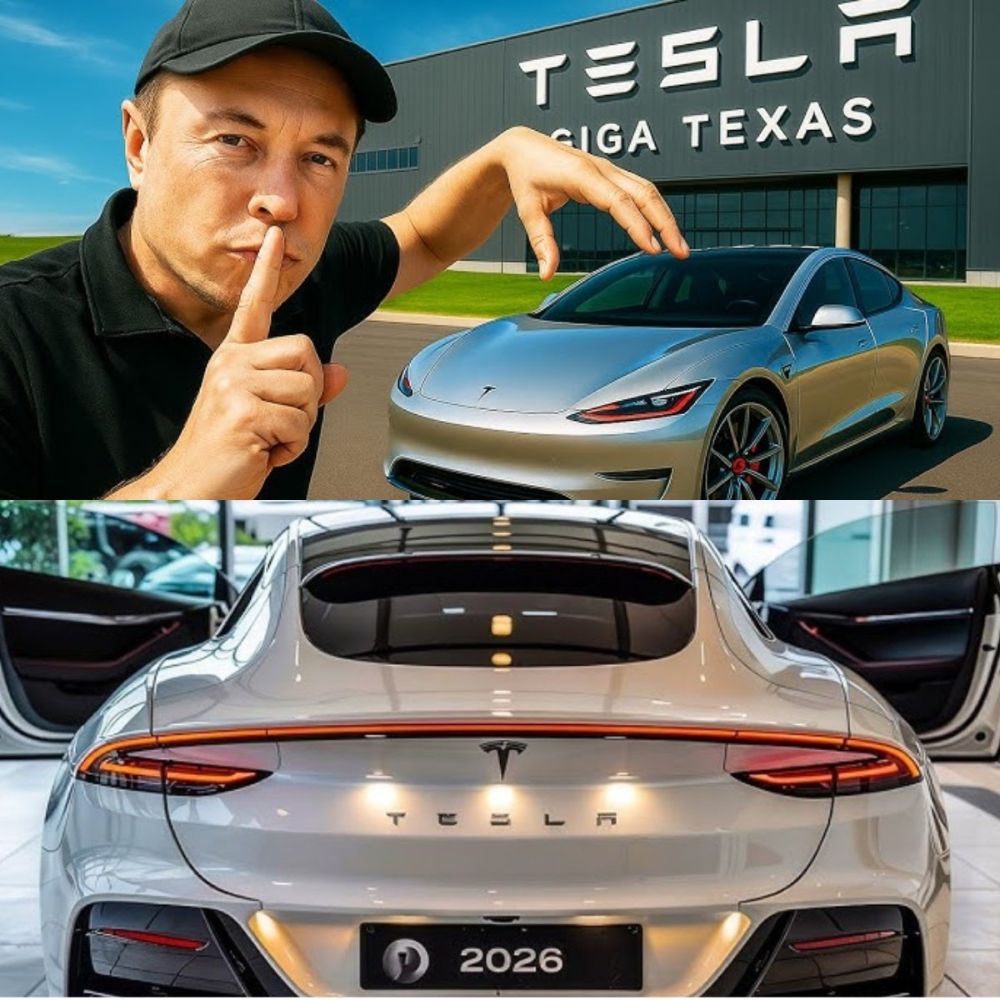
When Elon Musk first unveiled his “Secret Master Plan” nearly two decades ago, many dismissed his ambitions as fantasy.
The idea of building a high-performance electric sports car, then using the proceeds to develop a mass-market affordable EV, was considered an impossible dream in an industry dominated by century-old automakers.
Yet Tesla has already rewritten the history of transportation: from the Roadster to the Model S, from the affordable Model 3 to the global dominance of the Model Y.
Now, the next chapter is upon us. Tesla’s upcoming Model 2, expected to launch in 2026, is poised to become the most transformative car in the company’s history. If successful, it won’t just be another Tesla -it could very well be the spark that triggers the global tipping point toward mainstream electric adoption.
With a rumored price tag around $25,000, compact dimensions tailored for cities, and seven groundbreaking features, the Model 2 is shaping up to be Elon Musk’s boldest play yet a move that could send Tesla’s revenue soaring and permanently cement the company’s dominance in the EV era.
Advanced Autonomous DrivingTesla’s leadership in autonomous driving is already well established through Autopilot and Full Self-Driving (FSD) software. But the Model 2 could represent the true democratization of autonomy.
Imagine millions of drivers gaining access to advanced driver assistance at an affordable price point-technology that was once reserved for luxury vehicles now delivered to the masses.
More importantly, Elon Musk has consistently tied the Model 2 to his robotaxi vision. Musk has hinted that the next-generation platform will include versions without steering wheels or pedals, optimized for fully autonomous ride-hailing. If this comes to fruition, the Model 2 could double as a personal car and a revenue-generating robotaxi.
Sleek Compact DesignThe Tesla Model 2 is expected to be smaller and more compact than the Model 3, making it the perfect vehicle for congested urban centers. With more than half the world’s population living in cities, the need for compact, efficient, and eco-friendly mobility has never been greater.
Using innovations such as gigacasting, Tesla can reduce parts and streamline production, resulting in a car that’s both affordable and robust.
Cutting-Edge Battery TechnologyAt the heart of the Model 2 lies Tesla’s 4680 battery cells, with structural pack integration. This means:
Longer range (250-300 miles / 400-480 km)
Lighter, stronger design
Lower production costs
For drivers, it means range anxiety finally ends. For Tesla, it means another leap ahead of competitors.
Innovative Interior FeaturesTesla has always treated its cars like smartphones on wheels. Expect the Model 2 to feature:
Central touchscreen brain
Al voice control
Augmented reality HUD
Modular seats & eco-friendly interiors
And of course, Tesla’s signature over-the-air software updates ensure your Model 2 keeps evolving long after purchase.
Rapid ChargingThe Model 2 will harness Tesla’s V4 Superchargers, delivering up to 350 kW. That means:
10% → 80% charge in under 20 minutes
Smart integration with renewable energy
Vehicle-to-grid (V2G) home backup potential
Fast charging = true freedom on the road.
Competitive Price PointThe shocker: $25,000 Tesla.
This puts Model 2 in direct competition with Toyota Corolla, Honda Civic, and VW Golf-only it’s electric, smarter, and future-ready.
Musk’s vision is clear: just as the Model T put America on wheels, the Model 2 will put the world on electric wheels.
Sustainability EnhancementsThe Model 2 won’t just be affordable-it will be green at its core:
Recycled materials
Vegan leather interiors
“Unboxed” production process minimizing waste
Integration with clean energy sources
Each Model 2 replacing a gas car = tons of CO2 saved every year.
Beyond the Seven Features: Why It’s a True Game-Changer
Global reach: Perfect for markets like India, China, and Latin America.
Financial power: Millions of units per year = $100B+ annual revenue potential.
Mobility ecosystem: Works with Tesla Energy + Robotaxi network.
Cultural impact: Tesla ownership becomes mainstream, like owning an iPhone.
Challenges Ahead
Yes, risks exist: production delays, competition from China, regulatory hurdles. But if history is any guide, Musk thrives on “impossible.” From reusable rockets to global satellite internet to the world’s best-selling EV, he delivers.
Conclusion: Musk’s 2026 Game-Changer
The Tesla Model 2 is not just a car. It is Musk’s masterstroke-a $25,000, autonomous-ready, compact, sustainable EV for the masses.
It promises:
Advanced autonomy
Game-changing batteries
Ultra-fast charging
Unbeatable price
Mass electrification
If 2025 was about speculation, then 2026 will be the year Tesla changes everything.
Elon Musk’s greatest game-changer is coming-the Tesla Model 2.
The Tesla Model 2: The Turning Point Musk Has Been Building Toward
But to understand why the Model 2 matters so profoundly, it’s important to remember that Tesla is no longer just a car company. It is an ecosystem—a web of energy storage, charging, AI, autonomy, robotics, manufacturing, and software.
The Model 2 is the final missing piece that completes the system.
When Musk first presented his long-term roadmap, critics dismissed it as overconfidence. Now, nearly twenty years later, the Model 2 represents the moment when Tesla’s entire architecture converges: cheaper batteries, simplified manufacturing, AI-driven value, and global scalability.
And this is exactly why analysts are calling it the most disruptive consumer product of the decade.
The Production Revolution Behind the Model 2
One of the most overlooked aspects of the Model 2 is not the car itself—it’s how the car will be built.
Tesla’s new “unboxed” manufacturing process takes the concept of car production and flips it upside down.
Instead of assembling thousands of small parts into a single body, Tesla casts major sections of the vehicle in giant pieces, reduces factory space requirements, and eliminates manufacturing bottlenecks that have plagued automakers for decades.
This could lead to:
50% fewer production steps
60% reduction in factory footprint
70% lower assembly complexity
What does this mean for customers?
More cars.
Lower prices.
Faster delivery times.
Global scaling.
Legacy automakers have no answer for this—not yet, and possibly not for years.
A Car Designed for a Changing World
Transportation needs are changing rapidly. Cities are getting denser. Gas prices remain volatile. Climate change pressures governments to enforce stricter emissions laws.
And here comes the Model 2—arriving at the exact moment global demand is shifting toward small, clean, affordable mobility.
Europe wants compact EVs.
Asia wants urban mobility.
South America wants affordability.
The United States wants autonomy.
The Model 2 is all four at once.
Its compact footprint, flexible configuration, and software-first architecture make it everything a modern city—and a modern driver—needs.
The Robotaxi Connection
Musk has repeatedly said that Tesla’s long-term value is not in cars—it’s in software.
The Model 2 is built around this philosophy.
If Tesla achieves full autonomy at scale, the Model 2 becomes more than a personal vehicle—it becomes the backbone of Tesla’s robotaxi vision.
Imagine:
Your car earns money while you sleep.
Urban transportation becomes cheaper than owning a car.
Tesla generates recurring revenue from every autonomous mile driven.
One million Model 2s operating as robotaxis could theoretically generate tens of billions annually.
This is why Silicon Valley insiders say the Model 2 is not just a car but a business model.
Tesla’s Global Strategy: Why This Car Changes Everything
Tesla has already saturated high-end markets.
The next wave of expansion is:
India
Southeast Asia
Latin America
Eastern Europe
Africa
These regions have billions of potential customers who need reliable, clean, low-cost transportation.
The Model 2 is Tesla’s passport into these massive markets.
It becomes the first truly global EV in history—priced for the world, designed for cities, and optimized for scale.
Will Competitors Catch Up?
On paper, yes—Volkswagen, BYD, Toyota, and Hyundai all plan to release affordable EVs.
In reality, Tesla still holds the advantage in:
Battery innovation
Software integration
Charging networks
Manufacturing efficiency
Autonomous driving
Most automakers are still struggling to build profitable EVs.
Tesla, meanwhile, makes margins that other companies can’t match—even when selling cars at lower prices.
If Tesla delivers the Model 2 on time, competitors may face a disruption similar to what smartphones did to older industries.
The Psychological Factor: The Tesla Effect
There is something intangible about Tesla that competitors can’t replicate: cultural momentum.
Tesla is not just a brand—it’s a statement.
People who buy Teslas see themselves as part of the future.
The Model 2 will amplify that effect by making the “future” accessible to millions who previously couldn’t afford it.
Just as the iPhone transformed communication, the Model 2 may transform global mobility.
Obstacles Still Remain
Despite the hype, real challenges exist:
Global supply chain instability
Mineral shortages
Regulatory delays
Labor disputes
Chinese pricing pressure
Autonomy-related lawsuits
But Tesla thrives in chaos.
Every major achievement in the company’s history came during turbulent periods when experts confidently predicted its downfall.
This time, Musk’s ambitions are larger—but so is Tesla’s infrastructure.
What the Model 2 Means for Musk’s Legacy
If the Roadster made Tesla possible, and the Model S made Tesla desirable, and the Model 3 made Tesla scalable, then the Model 2 will make Tesla unavoidable.
It completes the Master Plan.
It expands Tesla’s reach to billions.
It electrifies the world faster than government policy alone ever could.
For Musk, this isn’t just another product launch.
It is the defining moment of his career—a moment that solidifies his place in technological history.
Final Thoughts: The Countdown to 2026 Begins
The Tesla Model 2 represents:
A breakthrough in affordability
A leap in battery innovation
A global manufacturing revolution
A real shot at mainstream autonomy
A cultural milestone in transportation
If Tesla succeeds, 2026 will be remembered as the year the world crossed the electric tipping point.
The Model 2 is more than a car.
It’s a catalyst.
A disruptor.
A global equalizer.
And perhaps, Musk’s most transformative creation yet.