

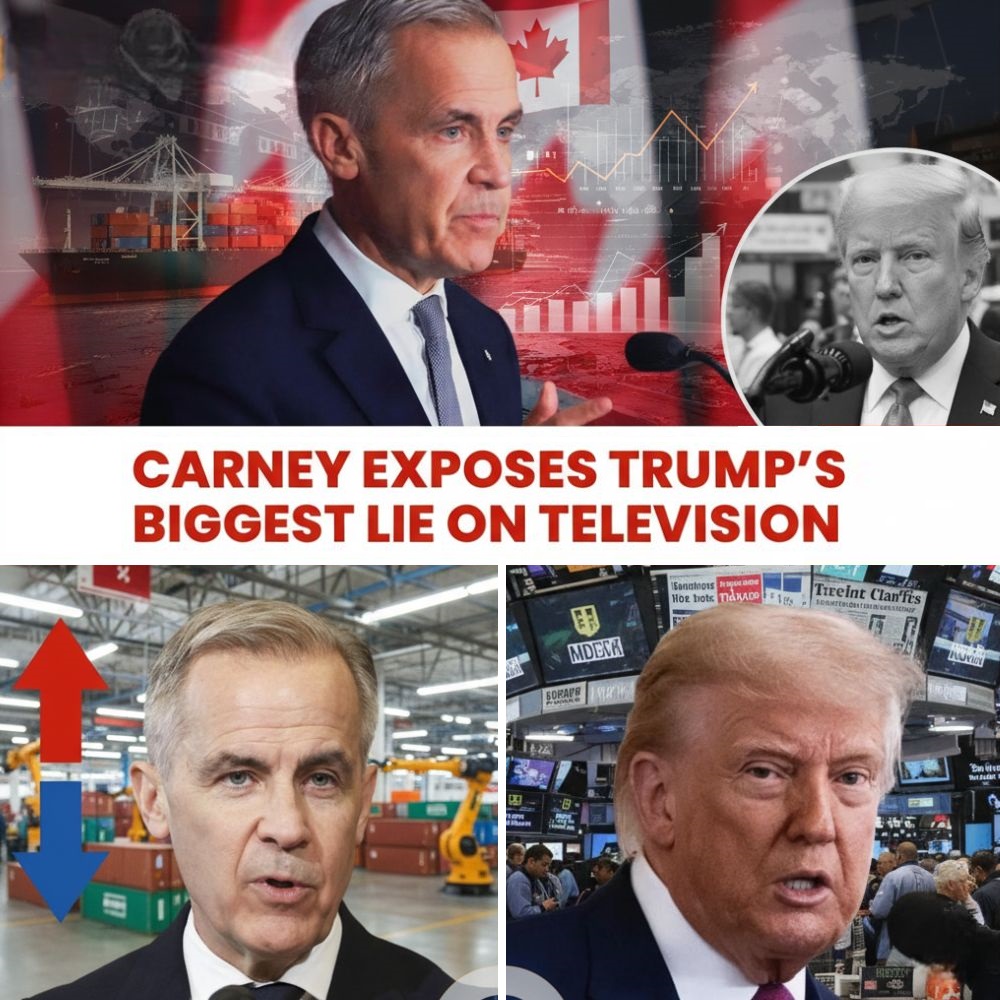
Trump Halts All Trade Talks With Canada After Ontario Airs Anti-Tariff Ad, Triggering a Cross-Border Political Storm
When President Donald Trump abruptly terminated trade negotiations with Canada this week, officials in both countries braced for a major policy shift. But the cause of the rupture was not a stalled negotiation, a disputed quota, or a diplomatic standoff. It was an advertisement.
The ad — produced not by the federal government, but by the Government of Ontario — aired widely across American networks. Featuring archival audio of Ronald Reagan, it warned viewers of the economic dangers of protectionism and reminded Americans that “high tariffs inevitably lead to retaliation.” The message was unmistakable: the Reagan-era Republican Party embraced open markets, not trade wars.
Within hours, Mr. Trump attacked the ad as “fraudulent” and “fake,” accusing Canada of misrepresenting Reagan’s legacy and claiming, without evidence, that the ad was designed to improperly influence an upcoming Supreme Court ruling on his tariff policy. By dawn, he announced on Truth Social that all trade talks with Canada were “terminated effective immediately.”
A Conflict Fueled by Pride, Not Policy
Economic advisers inside the White House privately describe the decision as reactive and emotionally charged. Publicly, officials attempted to frame the breakdown as the result of “longstanding frustrations,” with Kevin Hassett, director of the National Economic Council, suggesting Canada has been “difficult to negotiate with.”
But trade analysts and diplomats point to a simpler catalyst: the ad struck a nerve.
The 1987 Reagan clip — still widely available — includes the former president warning that tariffs are “a hidden tax on the consumer.” It was a direct contradiction to Mr. Trump’s claim that tariffs strengthen American leverage. And it undermined his repeated assertion that Reagan “loved tariffs,” a statement historians have consistently dismissed as inaccurate.
“Reagan wasn’t misquoted,” said a former U.S. trade official. “He was corrected.”
Carney’s Quiet Rebuttal
If the Trump administration’s response was explosive, Canada’s was measured.
Prime Minister Mark Carney, speaking at a scheduled press briefing, never mentioned Mr. Trump by name. Instead, he offered a single sentence that circulated rapidly through diplomatic circles:
“The 1980s were a different time. U.S. trade policy used to reflect shared prosperity.”
It was a subtle but unmistakable rebuke — a reminder that Reagan’s legacy is a matter of public record, not political reinvention. And it signaled that Canada would not be coerced into retracting the ad or apologizing for its content.
Carney later expanded on Canada’s position, noting that U.S. tariff policy had fundamentally shifted in recent decades and that Canadian officials have been negotiating “in good faith” on steel, aluminum, and energy despite escalating American pressure.
A Trade Relationship Under Stress — and a Canada Less Dependent on Washington
Behind the public tension lies a deeper reality: under Carney’s leadership, Canada has aggressively diversified its global trade relationships.
Deals with the European Union, India, Japan, and even China have expanded. Export volumes across sectors have grown. New supply chains have reduced dependence on American markets that once accounted for the overwhelming majority of Canada’s trade activity.
“Canada is no longer positioned to absorb economic shocks driven by U.S. politics,” said a senior diplomat in Ottawa. “Diversification has changed the calculus.”
Thus, when Mr. Trump walked away from negotiations, the move did not trigger panic in Ottawa. If anything, analysts say, it reinforced Canada’s long-term strategic shift: protect the American relationship, but never rely exclusively on it.
Rewriting History in the Spotlight
What turned a provincial advertisement into a cross-border conflict was not the policy content but the historical contradiction it revealed.
Reagan’s own words contradicted Mr. Trump’s tariff narrative.
Reagan’s economic philosophy contradicted Mr. Trump’s political messaging.
And Reagan’s legacy — a touchstone for the modern conservative movement — contradicted Mr. Trump’s claim to ideological lineage.
“When leaders attempt to rewrite history, the evidence becomes their opponent,” said a historian at the Hoover Institution. “In this case, the evidence was Reagan himself.”
A President on the Defensive
For months, Mr. Trump has faced criticism in Washington for losing leverage with Ottawa. His tariffs on Canadian steel and aluminum provoked retaliatory measures. Canadian manufacturing stabilized. U.S. import prices rose. And Mark Carney’s deliberate, technocratic approach consistently earned bipartisan praise at home.
By withdrawing from negotiations, analysts argue, Mr. Trump attempted to reassert control. But the optics have instead fueled a portrait of a president acting out of frustration, not strategy.
Canada Steps Forward, Even as Washington Steps Back
The collapse of talks leaves significant issues unresolved: agricultural access, energy cooperation, and steel supply chains among them. But Canadian officials insist their approach will not change.
“We will continue discussions with partners who share our commitment to fairness,” one senior official said. “We cannot control U.S. domestic politics. We can only respond with facts.”
A Diplomatic Break With Symbolic Weight
The Ontario ad did not attempt to provoke Washington. It stated a historical truth — that tariffs hurt consumers — in the voice of a president revered across the American political spectrum.
But the fallout underscores an evolving reality: Canada and the United States no longer share a unified economic worldview.
Where Reagan built alliances, today’s tensions fracture them.
Where tariffs were once rare, they are now commonplace.
Where diplomacy once guided trade, political theatrics increasingly define it.
“What happened this week wasn’t about economics,” said one trade expert. “It was about ego, history, and the power of a single sentence spoken in 1987.”
And as the dust settles, one fact is becoming clear:
When Trump walked away from the table, it was not Canada he left behind — it was the broader American tradition of open markets that Reagan once championed.