

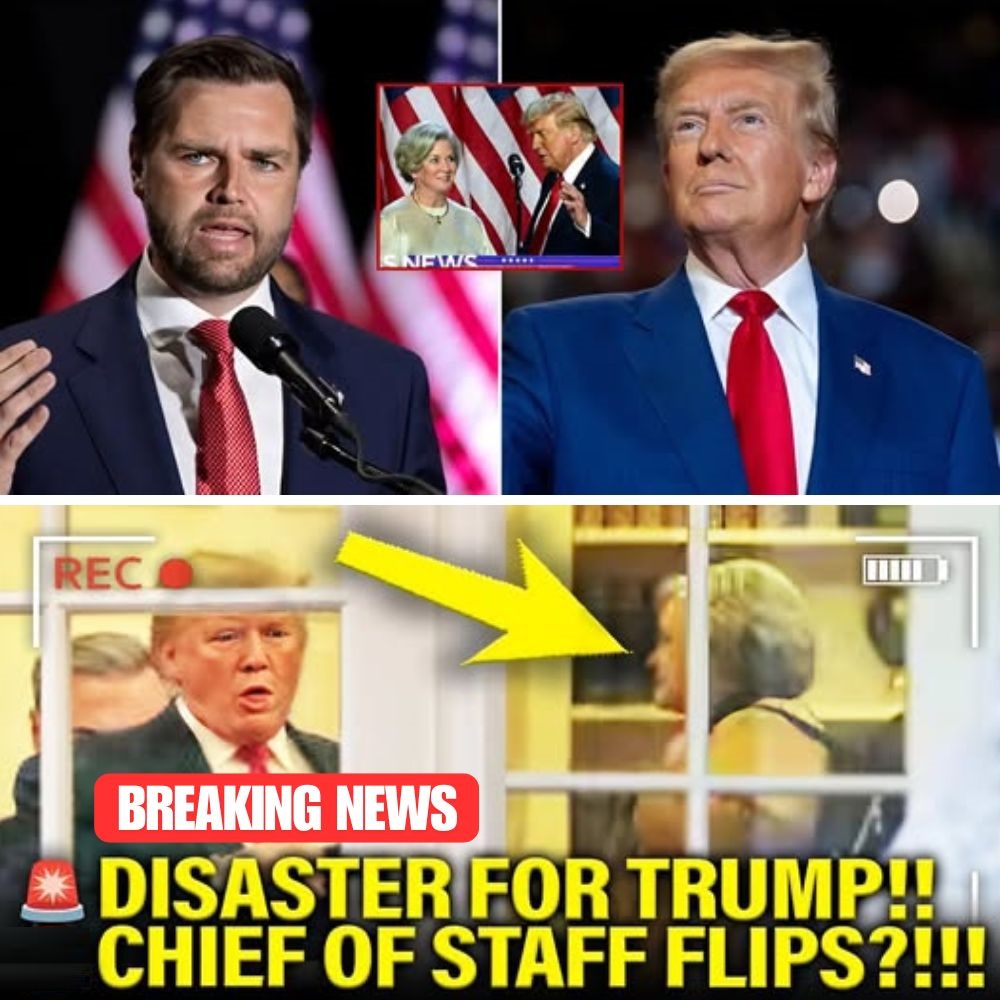
A Leaked Portrait of Discord Inside Trump’s Inner Circle, as Economic Strains Deepen
Donald Trump began Tuesday confronting an unusually public rupture within his own inner circle, as a two-part Vanity Fair article portrayed his chief of staff, Susie Wiles, offering a starkly critical assessment of the former president and several of his closest allies. Based on 11 interviews and extensive recorded material, the article described internal doubts, personality conflicts, and strategic tensions that contrast sharply with the administration’s public message of unity and control.
According to the author, Ms. Wiles characterized Mr. Trump as having what she described as an “alcoholic’s personality,” a term she used to suggest volatility and impulsiveness rather than substance abuse. She also portrayed Vice President J. D. Vance as a long-time conspiracy theorist whose evolution from Trump critic to ally, she said, was driven less by ideology than by political ambition during his Senate run.
Ms. Wiles’s remarks extended to other figures in Trump’s orbit. She described Elon Musk as an erratic presence whose decision-making could be difficult to predict, and she labeled Russell Vought, the architect of Project 2025 and now director of the Office of Management and Budget, a rigid ideological zealot. She was also sharply critical of Attorney General Pam Bondi, saying she mishandled matters related to the Epstein files.
On that subject, Ms. Wiles told the interviewer that Mr. Trump’s name does appear in Epstein-related documents, though she emphasized that she was not alleging criminal conduct. She said Mr. Trump had flown on Epstein’s plane and appeared on flight manifests during a period when both men were, in her words, “young, single playboys.” She rejected Mr. Trump’s repeated claims that former President Bill Clinton visited Epstein’s private island, saying she had seen no evidence supporting those allegations.
Ms. Wiles also sought to deflate speculation about Mr. Trump pursuing a third term. According to the article, she said he raised the idea largely to provoke reactions and generate attention, and that he privately acknowledged the constitutional prohibition imposed by the 22nd Amendment.
Another striking passage described Ms. Wiles discussing Mr. Trump’s approach to Venezuela. She told the interviewer that Mr. Trump favored continuing aggressive maritime operations until President Nicolás Maduro “cried uncle,” language that appeared to suggest regime-change ambitions rather than narrow drug interdiction. That account conflicts with the administration’s official framing of those actions.
After the article’s publication, Ms. Wiles publicly denied its characterization, calling it a hit piece and saying her comments were taken out of context. The author responded by noting that many of the statements were recorded. Vanity Fair stood by its reporting.
The article landed amid mounting economic anxiety that has increasingly complicated the administration’s messaging. New labor data released this week showed that job growth has slowed sharply since the spring, with economists describing the trend as a “hiring recession.” Nearly no net jobs have been added since April, wage growth has moderated, and approximately 710,000 more Americans are unemployed now than in late 2024. October saw net job losses, and November’s modest gains are widely expected to be revised downward.
Unemployment has risen to 4.6 percent, with youth unemployment reaching 10.6 percent, its highest level in the current cycle. Manufacturing payrolls declined again in November, marking the seventh consecutive monthly drop. Outside of health care and education—two sectors now facing budgetary pressure—private-sector job growth has been broadly negative.
Other cost pressures are intensifying. Electricity bills are projected to reach record highs for the third consecutive year, driven in part by the rapid expansion of energy-intensive data centers. Farmers, meanwhile, are pressing for additional federal assistance, with Republican lawmakers warning that earlier bailout packages may be insufficient to prevent a wave of bankruptcies.
Despite these trends, Mr. Trump and Mr. Vance have continued to present a confident public assessment of the economy. Mr. Trump recently graded it an “A++,” a mark echoed by Mr. Vance during a visit to Pennsylvania. At the same time, Mr. Vance acknowledged that affordability challenges would not be resolved quickly, a notable shift from campaign promises that prices would fall immediately upon Mr. Trump’s return to office.
Even conservative media outlets have begun to acknowledge stress points in the labor market, citing slowing job creation and the concentration of new employment in lower-paying health care roles.
Together, the Vanity Fair portrait and the economic data point to a moment of strain beneath the administration’s surface confidence: internal skepticism from senior aides, rising public costs, and a widening gap between political rhetoric and lived economic reality. Whether those pressures coalesce into lasting political consequences remains uncertain, but the tension is becoming increasingly difficult to conceal.