

A seismic shift in global energy power is unfolding off the coast of Venezuela, as China secures operational control of a major oil region, fundamentally altering the Western Hemisphere’s strategic landscape and challenging decades of American hemispheric dominance.
The dramatic move comes amidst a severe escalation of U.S. sanctions and military pressure intended to cripple the government of President Nicolás Maduro. In April 2025, Washington implemented sweeping secondary tariffs designed to punish any nation purchasing Venezuelan crude, a strategy meant to completely isolate Caracas from international oil markets.
Instead of capitulation, the sanctions created a vacuum that Beijing moved decisively to fill. In a bold strategic play, China deployed the Alula Jackup rig to Lake Maracaibo under a 20-year production agreement, signaling a long-term commitment far beyond simple trade.
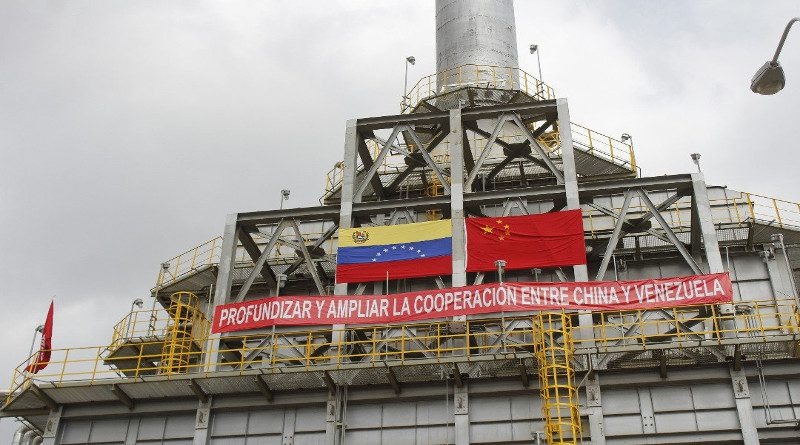
This platform grants China operational control of more than 500 wells, with teams of Chinese engineers now working to reactivate long-neglected fields. Production in the area, which had collapsed to 12,000 barrels per day, is now projected to reach 60,000 barrels daily by 2026.
China’s confidence stems from a diplomatic framework solidified in 2023, when both nations elevated their ties to an “all-weather strategic partnership.” This label proved critical, demonstrating Beijing’s willingness to cooperate with Caracas even under intense international pressure.
The partnership is underpinned by a powerful financial mechanism: Venezuela’s massive debt to China, exceeding $60 billion. These loans are repaid not in currency, but through direct oil shipments, creating an unbreakable flow of crude from Venezuelan fields to Chinese refineries.
By late 2025, nearly 90% of Venezuela’s oil exports were destined for China, either through direct transit or covert ship-to-ship transfers. December tanker reports showed exports surging to 966,000 barrels per day, the highest point in nearly a year.
The economic binding grew tighter in November 2025, when Caracas and Beijing finalized a zero-tariff agreement covering hundreds of product categories. This deal inextricably ties Venezuela’s economy to China’s supply chain, transforming temporary sanctions resistance into permanent structural dependence.
Facing this rapidly consolidating partnership, Washington turned to military tools in a dramatic escalation. In December 2025, U.S. forces seized a large crude tanker near Venezuelan waters, with footage showing Marines and Coast Guard personnel securing the vessel.
Venezuelan authorities condemned the act as an assault on sovereignty, with President Maduro calling for national resistance. It was not an isolated incident; the U.S. has conducted over 20 maritime interceptions across the Caribbean in recent months.
The crisis deepened further with the largest U.S. regional force deployment since the Cuban Missile Crisis. The posture includes F-35 fighter jets, the USS Gerald R. Ford aircraft carrier, and more than 15,000 personnel, actions analysts warn signal preparations for a potential full blockade.
Rather than deter Beijing, these military moves have only reinforced China’s resolve. Beijing issued strong condemnations and accelerated plans to deepen cooperation, providing Venezuela with diplomatic shelter against Washington’s pressure campaign.
The emerging pattern signals more than a bilateral dispute; it marks the formation of a new geopolitical frontier. Venezuela has become a stark demonstration of a multipolar world order where U.S. sanctions no longer guarantee compliance.
China’s strategy offers targeted states a viable alternative: access to alternative markets, long-term investment, diplomatic protection, and critical infrastructure development. This model is already resonating across Latin America, challenging traditional spheres of influence.
Brazil’s agricultural and industrial trade is increasingly tilting toward Beijing. Argentina relies heavily on Chinese capital for major infrastructure projects. Even Mexico maintains robust engagement with China despite U.S. pressure.
This transformation reveals a profound strategic challenge for Washington. A peer rival now holds durable, energy-backed influence in a nation possessing the world’s largest proven oil reserves, located just off the coast of Florida.
The struggle over Venezuelan oil is now a definitive test for the future of energy security, diplomatic coercion, and military deterrence. It forces a fundamental reassessment of how economic sanctions function when a rival superpower is willing and able to provide an alternative ecosystem.
The outcome will shape how nations choose partners in an era of great power competition. It will influence China’s confidence as it expands its reach into other contested regions globally. The era of uncontested American hemispheric authority appears to be over, with the global oil shock serving as its first, undeniable proof.