

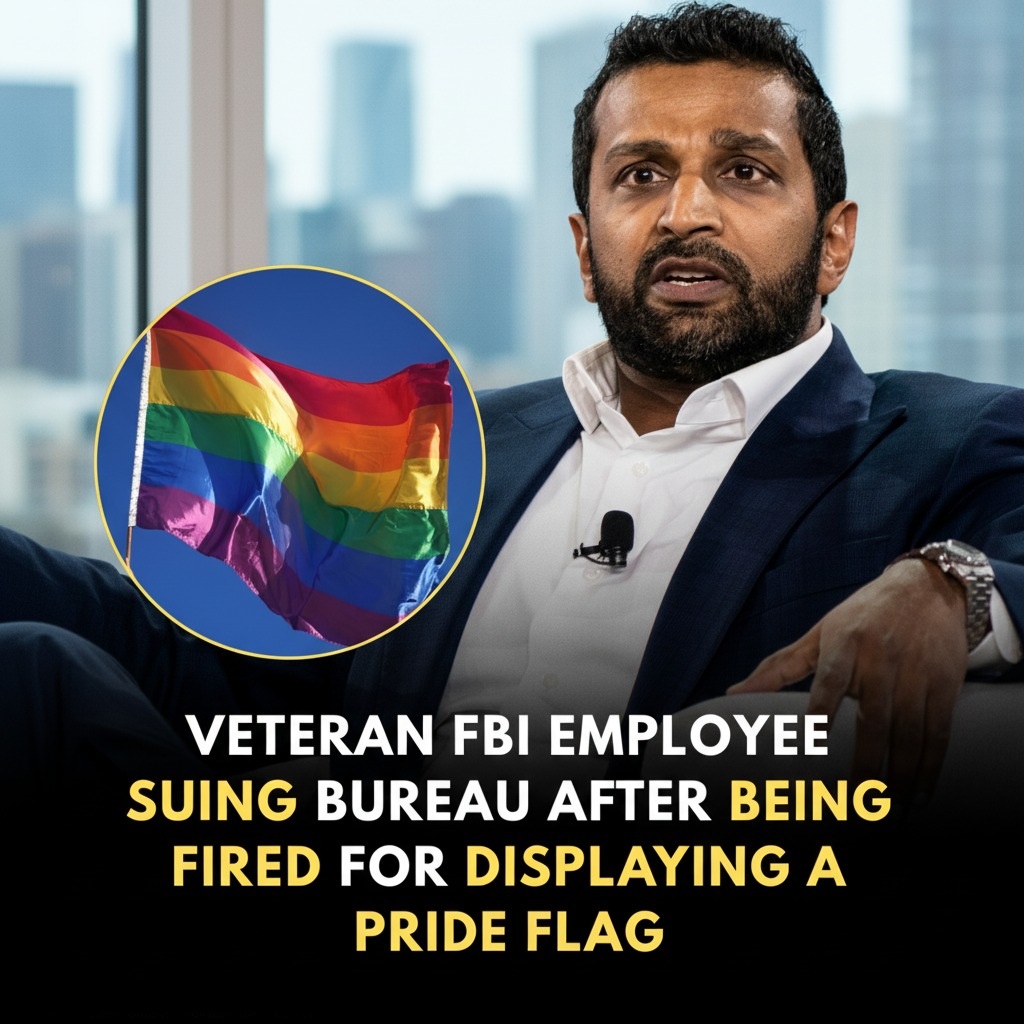
David Maltinsky, a former employee of the Federal Bureau of Investigation, has recently filed a lawsuit against the agency after being terminated for displaying a Pride flag at his workstation. According to Maltinsky, the flag had been approved by his supervisor and was a harmless expression of identity and inclusion. However, the FBI viewed the situation differently, pointing to internal policies that prohibit the use of workplace displays that could be interpreted as political or advocacy messaging. The case has now become a point of national conversation, raising questions about workplace neutrality, employee rights, inclusivity, and the standards that federal agencies are expected to uphold.
To fully understand the situation, it is essential to examine both the employee’s argument and the FBI’s long-standing regulations. Maltinsky’s position is that his display of the Pride flag was not intended as a form of political lobbying, campaigning, or persuasion. Instead, he describes it as a personal symbol of identity, equality, and support for LGBTQ+ individuals in the workplace. He maintains that many workplaces today encourage employees to bring their “whole selves” to the office and that advocacy for diversity and inclusivity is not only common but often encouraged. Given that the flag was initially approved by a supervisor, Maltinsky argues he had no reason to believe he was in violation of any rule. His firing, he states, was unjust and retaliatory.
The FBI, however, has presented a contrasting perspective grounded in its internal codes of conduct. As a federal law enforcement agency, the FBI maintains particularly strict policies designed to protect its neutrality and public integrity. These policies exist precisely because federal agencies must serve all citizens equally and avoid even the appearance of political influence, partisanship, or ideological pressure. The FBI’s guidelines on workplace signage and displays are clear that personal expressions that could be perceived as politically symbolic are not permitted, especially if they could signal internal favoritism, bias, or advocacy.
From the FBI’s standpoint, the Pride flag—even though widely recognized as a symbol of identity and civil rights—has become associated with political movements, legislative campaigns, and social activism. Whether or not employees believe this association is fair, the agency must judge based on how any display might be interpreted by the public, government oversight bodies, or individuals within the workplace. The FBI argues that the responsibility to maintain neutrality is especially urgent in an era when symbolic imagery can quickly become part of public debate. In that context, an agency with the FBI’s visibility cannot risk being perceived as endorsing any political position, no matter how benign the employee’s personal intention may be.
This disagreement between Maltinsky and the FBI highlights a growing tension in modern professional environments. On one side, many contemporary workplaces emphasize diversity, inclusion, and the freedom for employees to express themselves as unique individuals. On the other hand, organizations—particularly those operating in the public sector—must exercise caution when it comes to taking or appearing to take a stance on cultural, political, or legislative issues. For private companies, the balance may be easier to achieve; they can choose to openly align with social causes. However, public institutions must adhere to higher standards of impartiality because their missions and responsibilities require universal trust.
In the lawsuit, Maltinsky contends that the bureau failed to properly interpret or apply its own policy. He argues that no disruption, complaint, or workplace imbalance occurred as a result of the flag, and that if the supervisor approved it, he should have been protected from disciplinary action. He also asserts that the rule itself is flawed because it does not clearly distinguish between personal identity expression and political messaging. If employees can display small personal items that express their background, culture, or personality, why should LGBTQ+ identity be singled out as political? He maintains that the issue is not neutrality, but inconsistency and selective enforcement.
The FBI counters that proper enforcement of policy does not depend on whether an incident causes disruption, but on whether it has the potential to violate internal standards. The agency also reports that approval by a supervisor does not override agency-wide regulations and that employees are responsible for complying with official policy regardless of supervisory oversight. If rules could be invalidated every time an individual supervisor gave informal permission, the organization’s standards would become impossible to enforce consistently.
Maltinsky’s lawsuit further suggests that the FBI’s decision reflects broader cultural resistance within federal institutions to LGBTQ+