

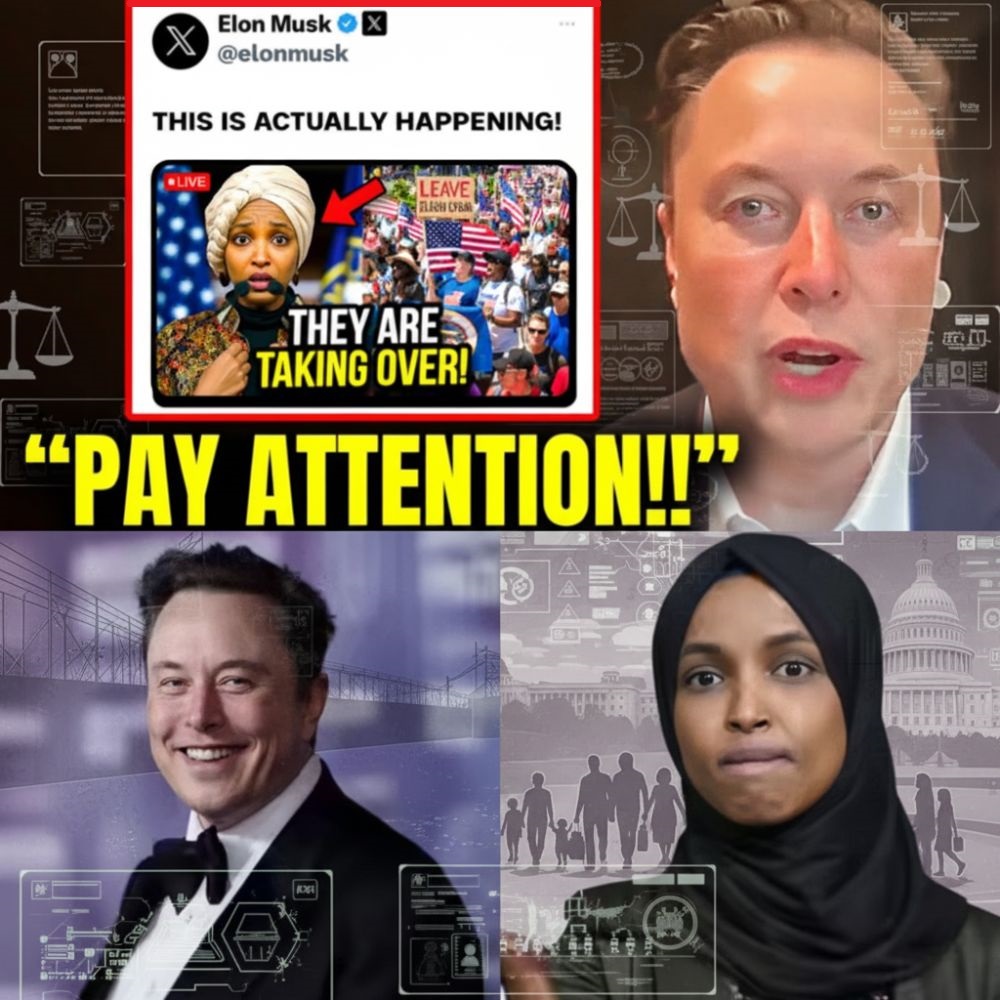
Elon Musk Sparks Controversy Over Ilhan Omar Video: A Deep Dive into the Debate on Loyalty, Treason, and Identity in American Politics
Introduction
In the age of viral social media moments and heightened political polarization, few figures can ignite nationwide debate quite like Elon Musk. Recently, Musk posted a video about Congresswoman Ilhan Omar that has sent shockwaves across the internet, stirring up discussions about national loyalty, foreign interests, and what it truly means to serve in the United States government. The resurfaced video, in which Omar is alleged to have claimed that the United States government acts in accordance with Somali interests, has been labeled by Musk as “treason.” The ensuing conversation has drawn in voices from across the political spectrum, exposing deep anxieties about assimilation, representation, and the boundaries of patriotism in America.
This article examines the controversy in detail, exploring the origins of the viral video, Musk’s commentary, the reactions from both the left and right, and the broader implications for American democracy.
The Viral Video: What Did Ilhan Omar Say?
The heart of the controversy stems from a video clip of Ilhan Omar, a Somali-American Congresswoman representing Minnesota’s 5th district. The clip, which Musk amplified to his massive following, is purported to show Omar stating that “the United States will do what Somalians tell them to do,” and that “Somalia will never be in danger as long as I am in Congress.” In the video, Omar is heard assuring her Somali constituents that she will protect their interests, particularly regarding Somalia’s territorial integrity and the security of its waters.
Translated portions of the video include statements such as:
“For as long as I am in the US Congress, Somalia will never be in danger. Its waters, the Indian Ocean, will not be stolen by Ethiopia or others.”
“The US would not dare to support anyone against Somalia to steal our land or oceans. Sleeping comfort knowing I am here to protect the interests of Somalians from inside the US system.”
These remarks, when taken out of context, have been interpreted by Musk and others as evidence of divided loyalty, or even treason.
Elon Musk’s Reaction: Accusations of Treason
Elon Musk, known for his provocative and often controversial social media presence, did not mince words in his response to the clip. Posting the video to his followers, Musk declared, “This sounds like treason.” He went on to elaborate on a podcast, expressing concern that elected officials like Omar and others might be prioritizing the interests of foreign nations over those of the United States.
Musk’s comments reflect a broader anxiety about demographic changes and the influence of immigrant communities on American politics. He suggested that politicians like Omar were elected by “a large group of people from Somalia who are in Minnesota,” and questioned whether these voters and their representatives truly assimilate into American values.
Further, Musk criticized the left for allegedly “importing a compliant electorate” that he believes is more receptive to progressive ideology, claiming that “actual Americans reject their poisonous ideology.” He argued that this trend represents a “deliberate subversion of our sovereignty where foreign interests override the will of the native population.”
The Broader Debate: Assimilation, Representation, and Patriotism
Musk’s remarks have sparked intense debate about what it means to be an American, who gets to participate in the democratic process, and whether elected officials should be allowed to advocate for the interests of their heritage countries.
Assimilation and Identity
At the core of the controversy is the question of assimilation. Critics argue that immigrant communities and their representatives are not sufficiently integrating into mainstream American culture, instead bringing “foreign politics into Congress.” Supporters, however, contend that America’s strength lies in its diversity and the ability of citizens from all backgrounds to participate fully in the political process.
The debate is not new. Throughout American history, waves of immigrants have faced suspicion and accusations of divided loyalty, from Irish and Italian Americans in the early 20th century to Japanese Americans during World War II. Today, the focus has shifted to Muslim and African immigrants, particularly those who achieve political power.
Representation and Advocacy
Another dimension of the debate centers on the role of elected officials. Should Congress members advocate for the interests of their ethnic or national communities, or should their loyalty be solely to the United States? Omar’s statements, if interpreted as a pledge to protect Somalia’s interests from within the US government, raise uncomfortable questions about the limits of advocacy and representation.
However, it is important to note that members of Congress routinely advocate for the interests of various communities, both domestic and international. For example, Irish-American politicians have long supported peace initiatives in Northern Ireland, while Jewish-American lawmakers often advocate for strong US-Israel relations.
Double Standards? Comparing Omar and Ted Cruz
The controversy took a new turn when commentators began comparing Omar’s remarks to those of Senator Ted Cruz, who once stated, “I came into Congress to serve Israel and I work every day to do that.” Critics argue that if Omar’s advocacy for Somalia constitutes treason, then Cruz’s open support for Israel should be viewed similarly.
This comparison highlights the complex web of loyalties and interests that characterize American politics. The United States has always been a nation of immigrants, and its foreign policy is shaped by the diverse backgrounds and priorities of its citizens and their representatives.
Treason or Advocacy?
The legal definition of treason is narrowly defined in the US Constitution as “levying war against [the United States], or in adhering to their enemies, giving them aid and comfort.” Advocacy for the interests of another country, even by an elected official, does not meet this threshold. Nonetheless, the rhetoric surrounding Omar and Cruz illustrates the ways in which accusations of treason are often wielded as political weapons rather than legal charges.
The Political Fallout: Left vs. Right
Musk’s intervention has drawn criticism from both sides of the political aisle, though the intensity varies. Some on the right have accused Musk of hypocrisy, noting that he himself was born in South Africa and only later became a US citizen. Others on the left have condemned the attack on Omar as xenophobic and Islamophobic, arguing that it perpetuates dangerous stereotypes about immigrants and Muslims.
Supporters of Musk, however, maintain that the issue is not Omar’s heritage but her statements and actions as a member of Congress. They argue that elected officials must be held to the highest standard of loyalty to the United States, regardless of their background.
The Role of Social Media
Social media has played a pivotal role in amplifying the controversy. Musk’s massive following ensures that his posts reach millions of people, shaping public opinion and fueling debate. The viral nature of the video has made it difficult to separate fact from fiction, with many viewers reacting to out-of-context clips rather than the full story.
Context and Nuance: What Did Omar Really Mean?
As with many viral controversies, context is key. Omar’s remarks were made in a conversation with Somali constituents, many of whom are deeply concerned about the security and sovereignty of their homeland. Her pledge to protect Somalia’s interests can be seen as an attempt to reassure her community that she will advocate for their concerns within the bounds of US law and policy.
It is not uncommon for elected officials to address the concerns of their ethnic or national communities, especially in districts with large immigrant populations. Such advocacy does not necessarily imply disloyalty to the United States.
Historical Parallels and Lessons
The controversy over Omar and Musk’s comments echoes historical debates about loyalty and assimilation in American politics. From the Red Scare to the internment of Japanese Americans, fears of foreign influence have often led to discrimination and the erosion of civil liberties.
Yet, America’s greatest strength has always been its ability to integrate diverse peoples and perspectives into a shared national identity. The presence of Somali, Jewish, Irish, and other voices in Congress reflects the pluralism that defines the country.
Conclusion: Where Do We Go From Here?
The debate ignited by Elon Musk’s viral post about Ilhan Omar is emblematic of deeper tensions in American society. Questions of loyalty, representation, and identity are not easily resolved, and accusations of treason are unlikely to foster constructive dialogue.
As the United States continues to grapple with issues of immigration, assimilation, and national identity, it is essential to approach these debates with nuance and respect for the complexity of American democracy. Elected officials must serve the interests of all their constituents, balancing the needs of diverse communities with their duty to the nation as a whole.
Ultimately, the controversy over Omar’s remarks and Musk’s reaction is a reminder that democracy thrives on debate, dissent, and the free exchange of ideas. Rather than resorting to accusations and outrage, Americans must engage thoughtfully with the challenges of representation in a pluralistic society.
Final Thoughts
The viral video and ensuing debate offer a window into the anxieties and hopes that shape American politics today. As the country becomes ever more diverse, the challenge will be to forge unity without demanding uniformity, and to ensure that all voices are heard and respected in the halls of power.
Whether one agrees with Musk, Omar, or Cruz, the essential question remains: What does it mean to be an American, and how can we ensure that our democracy reflects the values of inclusion, loyalty, and justice for all?