

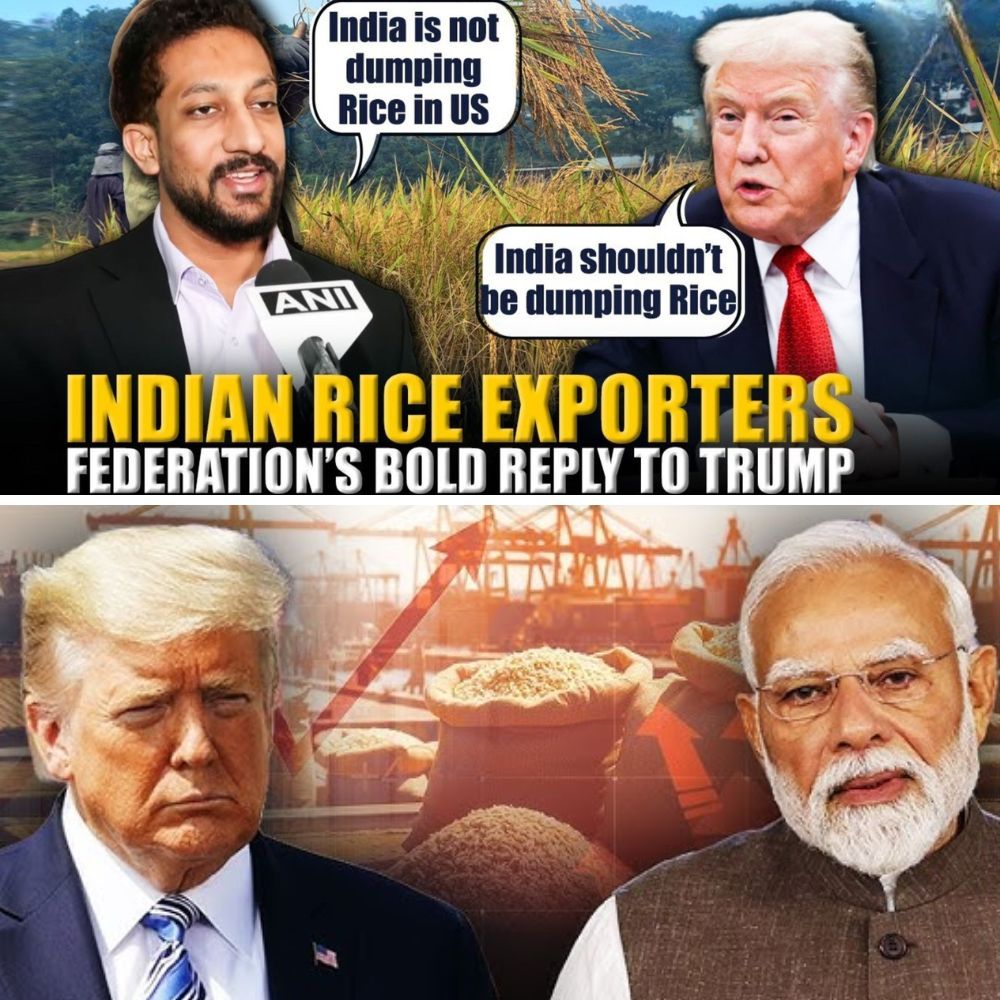
Indian rice exporters federation gives bold reply to Trump’s tariff threat against Indian Rice।
Regarding the recent remarks by the U.S. President on Indian rice imports, the Indian Rice Exporters Federation would like to clarify the facts and market dynamics of Indo-U.S. rice trade.
The United States is an important and growing market for India. In FY 2024–25, India exported 270,000 metric tons of basmati rice worth $337 million to the U.S., making it the fifth-largest market for Indian basmati. For non-basmati rice, India exported 61,000 metric tons worth $57 million, placing the U.S. as the 24th-largest market.
These exports are entirely demand-driven. The primary consumers are communities from India, Pakistan, Bangladesh, Afghanistan, Iraq, and Iran who prefer Indian rice for its distinct aroma, texture, and suitability for traditional dishes like biryani. American-grown rice is not a like-for-like substitute, and therefore Indian rice cannot be replaced in these cuisines.
India is not dumping rice in the U.S. market. In fact, when U.S. tariffs increased from 10% to 50%, Indian export volumes remained stable—showing that demand is based on necessity, not subsidies. What has changed is the price paid by the U.S. consumer: a standard 10-pound bag that earlier cost around $13 now sells for $18–19, contributing directly to food inflation in the U.S. The tariff burden is entirely borne by American households, not Indian exporters.
While the U.S. is a valued partner, India’s rice exports are diversified globally. For example, the Philippines—where India currently holds only a 4% share—is a market ten times larger than the U.S.
Any further tariff increases will hurt U.S. consumers, but will have minimal impact on India’s trade.