

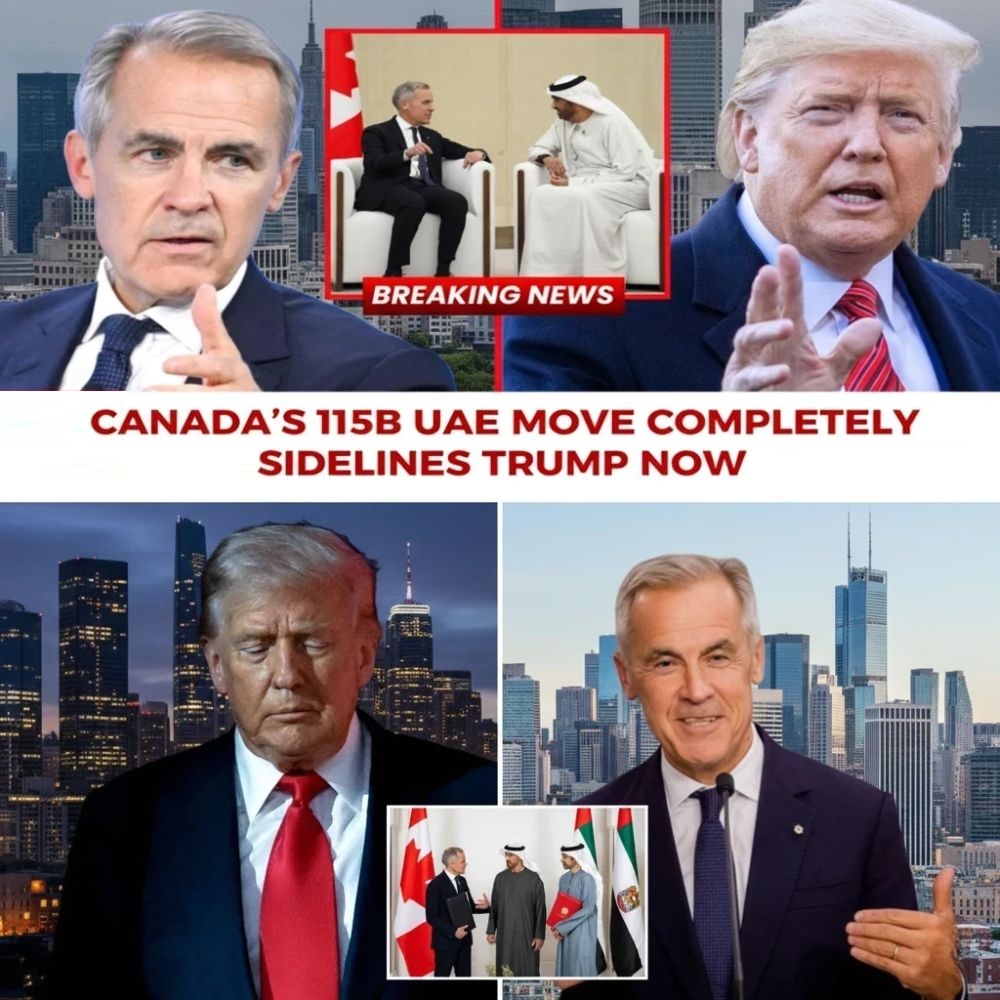
In a bold strategic pivot, Canada has inked a monumental $115 billion investment and partnership agreement with the United Arab Emirates, signaling a decisive shift away from economic reliance on the United States and charting a new course in global trade. The deal, unveiled by Prime Minister Mark Carney in Abu Dhabi, represents one of the largest external investment packages in Canadian history and a clear declaration of national confidence.
The agreement includes a long-awaited Foreign Investment Promotion and Protection Agreement (FIPA), unlocking tens of billions in future capital flows. Both nations also committed to negotiating a Comprehensive Economic Partnership Agreement, a modern trade pact designed to eliminate tariffs and anchor long-term supply chains. The partnership targets key sectors including engineering, construction, aerospace, artificial intelligence, and critical minerals.
Carney addressed a summit of Emirati leaders, investors, and CEOs with striking bluntness, stating that Canadians have become united in response to fundamental changes in U.S. trade policy. His remarks underscored a practical reality: under President Donald Trump’s second-term protectionist agenda, Canada is actively diversifying its economic relationships to ensure its future prosperity. This move comes as the United States has imposed sweeping tariffs on Canadian goods, citing national security concerns. These measures have escalated into a full-scale trade war, with duties on steel, aluminum, and auto parts rising as high as 35%. The White House strategy, intended to force Canadian concessions, has instead galvanized public opinion and political will north of the border.
The Canadian response has been multifaceted and strategic. Beyond the UAE deal, Ottawa is aggressively pursuing trade pacts across Asia and has finalized a major economic and security agreement with the European Union. Carney’s government is fast-tracking over $10 billion in nation-building projects, including a new deep-water port in Montreal, expanded energy corridors, and critical mineral infrastructure.
A quiet but powerful consumer boycott of American goods and tourism, supported by roughly 80% of Canadians according to recent polling, has further demonstrated national unity. This grassroots movement has begun to economically impact U.S. border communities, with tourism revenues falling and cross-border shopping declining sharply. In Washington, a remarkable bipartisan coalition in the U.S. Senate is now pushing back against the administration’s tariffs. Senators led by Amy Klobuchar have introduced a resolution to terminate the national emergency declaration used to justify the duties, arguing they harm American consumers and businesses more than they help.
A federal trade court panel has unanimously ruled the administration’s use of emergency powers for tariffs unlawful, underscoring a constitutional clash over presidential authority. Economists testify that the constant policy shifts are creating untenable uncertainty, stifling investment and planning for companies dependent on North American supply chains.
Carney, in a recent address to the Council on Foreign Relations in New York, framed Canada as a stable, resource-rich alternative in a volatile world. He highlighted Canada’s status as an energy superpower, a top-tier holder of critical minerals, and a leader in AI development, pitching the nation as a reliable partner for global capital.
The UAE partnership exemplifies this new posture. Both nations are energy powers positioned on major trade routes and share ambitions in clean technology and digital infrastructure. The deal includes collaboration on critical minerals processing, an area where the U.S. remains dependent on foreign supply chains, particularly China.
Analysts see the $115 billion plan as a structural realignment. Canada is positioning itself at the center of multiple global networks—in Asia, Europe, and the Middle East—rather than remaining solely within Washington’s orbit. This provides unprecedented leverage for Ottawa as the 2026 review of the USMCA trade agreement approaches.
The shift is not framed as anti-American but pro-Canadian. Each new tariff announcement from Washington has accelerated Ottawa’s diversification efforts and strengthened domestic support for building economic independence. Canadian pension funds, managing over $2 trillion in assets, are now looking toward partners like the UAE. As the U.S. administration wrestles with internal political and legal challenges to its trade policy, Canada is executing a calm, consistent strategy. The message from Ottawa is one of disciplined confidence: real strength is measured not by the volume of rhetoric but by the steadiness of execution and the quality of new partnerships forged.
The coming months will test whether this moment crystallizes into lasting momentum. Canada has moved from knocking on doors to setting the table, inviting the world to build alongside it. The question now is how quickly the United States will recognize that its northern neighbor no longer lives in its shadow and is writing a new economic story for itself.