

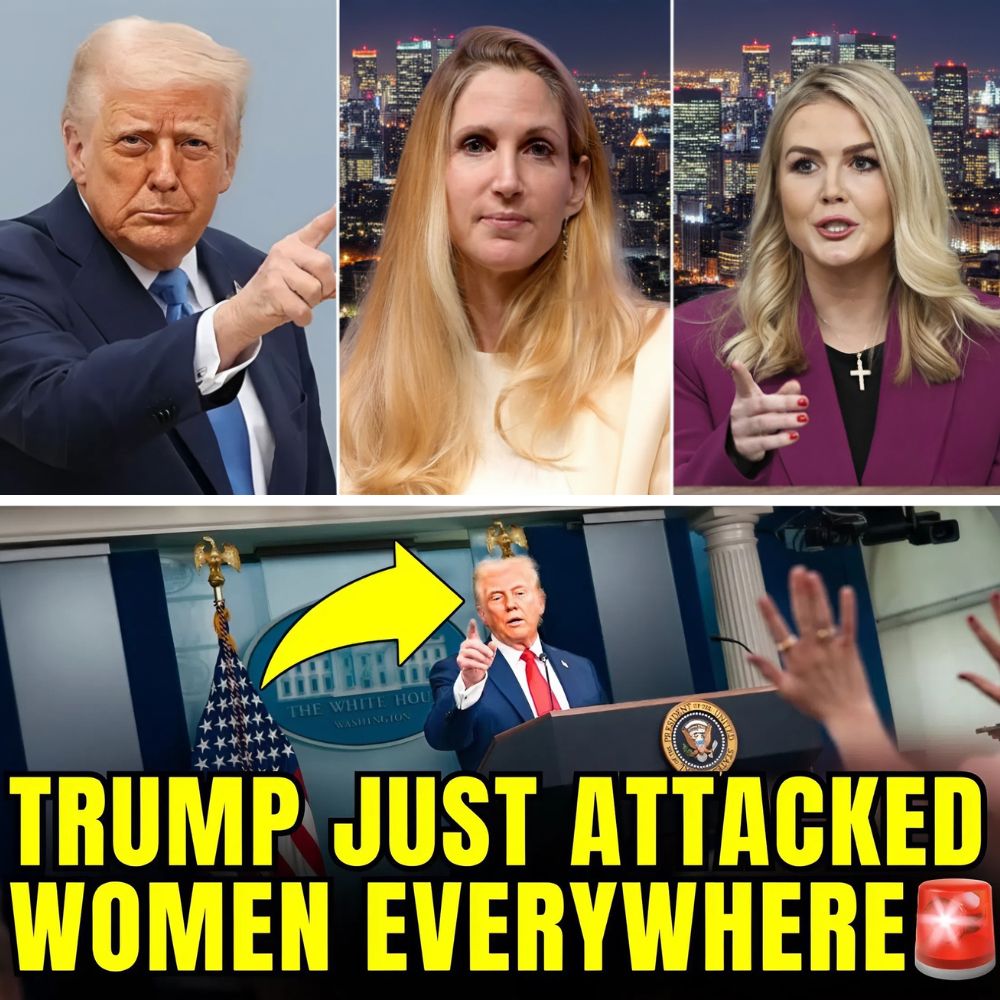
As Some MAGA Figures Call to Repeal Women’s Voting Rights, Trump Faces a Growing Political Liability
In the modern American political landscape, few voter blocs are as consequential—or as scrutinized—as suburban and independent women. Yet even as former President Donald J. Trump seeks to regain the White House, a far-right movement loosely aligned with parts of his base has increasingly embraced rhetoric that challenges the very foundation of women’s political participation: the right to vote itself.
The trend, once a fringe curiosity within online extremist communities, has gained visibility in recent months as prominent MAGA-aligned commentators, Christian nationalist pastors and right-wing influencers openly call for the repeal of the 19th Amendment, which enshrined women’s suffrage in 1920. While there is no realistic path to undoing the constitutional amendment, the language has unsettled Republican strategists concerned about Trump’s already-fraught standing with women voters.
A Candidate Struggling With Female Voters
Mr. Trump’s electoral struggles with suburban women have been well-documented. During his 2020 campaign, he pleaded publicly, “Suburban women, will you please like me?” before later dismissing the remark as a joke in a contentious interview with “60 Minutes.”
Inside Trump’s political orbit, advisers have long acknowledged a persistent gender gap. Polling throughout 2024 and 2025 has consistently shown that women—particularly independents and college-educated suburban voters—remain one of the former president’s weakest demographics.
Yet at the same moment that Trump’s allies attempt to broaden his appeal, notable voices within the MAGA ecosystem are promoting a philosophy that appears fundamentally incompatible with expanding female voter support.
The Reemergence of Anti-Suffrage Rhetoric
The renewed attention to anti-suffrage sentiment intensified earlier this month after The Guardian published an analysis by columnist Moira Donegan, who warned that a growing number of MAGA-aligned influencers and religious leaders have begun “saying the quiet part out loud.” Donegan noted that while anti-suffrage views have long existed on the fringes of the American right, they have recently migrated into more mainstream conservative spaces.
Among the most vocal advocates is Dale Partridge, a far-right Christian nationalist pastor who argued that the United States should reconsider the 19th Amendment “because I love America.” Anti-feminist commentator Hannah Pearl Davis, influencer Andrew Tate, and Idaho-based pastor Doug Wilson have echoed similar views, repeatedly calling for women to lose voting rights.
For years, author Ann Coulter has suggested that removing women from the electorate would produce more conservative outcomes. But until recently, such rhetoric rarely escaped the margins of political discourse. What has alarmed analysts is the ease with which these arguments now circulate among MAGA supporters online.
“There is no path to repealing the 19th Amendment,” Donegan wrote, emphasizing that advocates lack both political influence and institutional support. “But their visibility reflects a growing movement to blame women’s advancement for a wide range of social problems.”
Contradictions Inside the GOP
The escalating rhetoric comes at an inconvenient moment for Republicans, many of whom are already working to defend their voting policies from criticism that they may restrict women’s ballot access.
During a recent White House briefing, press secretary Karoline Leavitt attempted to quell concerns that new voter ID laws supported by the GOP could inadvertently make it more difficult for married women—particularly those who change their last names—to vote.
“That is a complete fallacy,” Ms. Leavitt said, describing the Safeguard American Voter Eligibility Act as a “common-sense measure” meant to verify citizenship. As a married woman herself, she insisted, she would not support a bill that compromised women’s ballot access.
But her remarks did little to blunt the growing narrative that elements of the far right view women’s political participation as conditional at best—and undesirable at worst.
Political scientists note that such messaging may undercut Republican outreach efforts, regardless of whether mainstream GOP leaders endorse it. “When influential voices on the right openly suggest women shouldn’t vote, it reinforces the perception that the party is hostile to female voters,” said Dr. Laura Jennings, a professor of political behavior at Stanford University.
Trump’s Paradox: Appealing to Women While Appeasing His Base
The tension between fringe anti-suffrage activism and Trump’s electoral strategy illustrates a recurring paradox of his political movement: the former president must hold together a coalition that includes both moderate, suburban swing voters and hardline online influencers whose rhetoric often alienates them.
Mr. Trump has repeatedly touted the loyalty of evangelical Christians and, in a now-famous statement from the 2016 campaign, declared, “I love the poorly educated.” But the same groups most animated by anti-suffrage rhetoric—reactionary internet personalities, male-dominated “manosphere” communities, and Christian nationalist pastors—are also among Trump’s most enthusiastic supporters.
“He’s going to do it whether the women like it or not,” Trump once joked at a campaign rally, a line critics often cite as symbolic of his dismissive posture toward female voters.
Meanwhile, many strategists warn that such messaging risks alienating the very demographic Trump needs most. “You can’t win a national election without independent female voters,” said Ana Reyes, a Republican pollster in Arizona. “And this rhetoric does nothing but damage.”
A Movement With No Legislative Future—But Cultural Influence
No serious lawmaker has introduced legislation to challenge women’s voting rights. Constitutional scholars emphasize that repealing the 19th Amendment would require an extraordinary political coalition—two-thirds of Congress and ratification by three-fourths of the states—making the prospect functionally impossible.
But the movement’s significance lies less in its likelihood of success and more in what it reflects about a shift in political culture. Experts say the anti-suffrage rhetoric is part of a broader backlash to women’s increased participation in public life over the past century.
“These ideas flow from a worldview that sees women’s equality as destabilizing to the social order,” said Martha Levine, a historian of gender politics. “The danger is not that the amendment will be repealed, but that these narratives normalize the idea that women’s citizenship is contingent.”
A Strategic Blind Spot for Trump’s Campaign
For now, the Trump campaign has not publicly addressed the anti-suffrage calls emanating from parts of his base. But with women—especially suburban voters—expected to play a decisive role in the upcoming election, the movement’s visibility presents a clear political challenge.
Republican strategists are quick to note that Trump cannot afford to lose ground among female voters. He lost women by double digits in both 2016 and 2020, according to exit polls. Polling in 2025 indicates that gap has widened further.
As political observers continue to watch the right’s internal debates over women’s political participation, one question looms over Trump’s reelection bid: Can a campaign so dependent on a fervent online base moderate its message enough to retain the voters he needs most?
For now, the paradox remains unresolved—leaving the political future of the GOP, and the role of women within it, increasingly uncer