

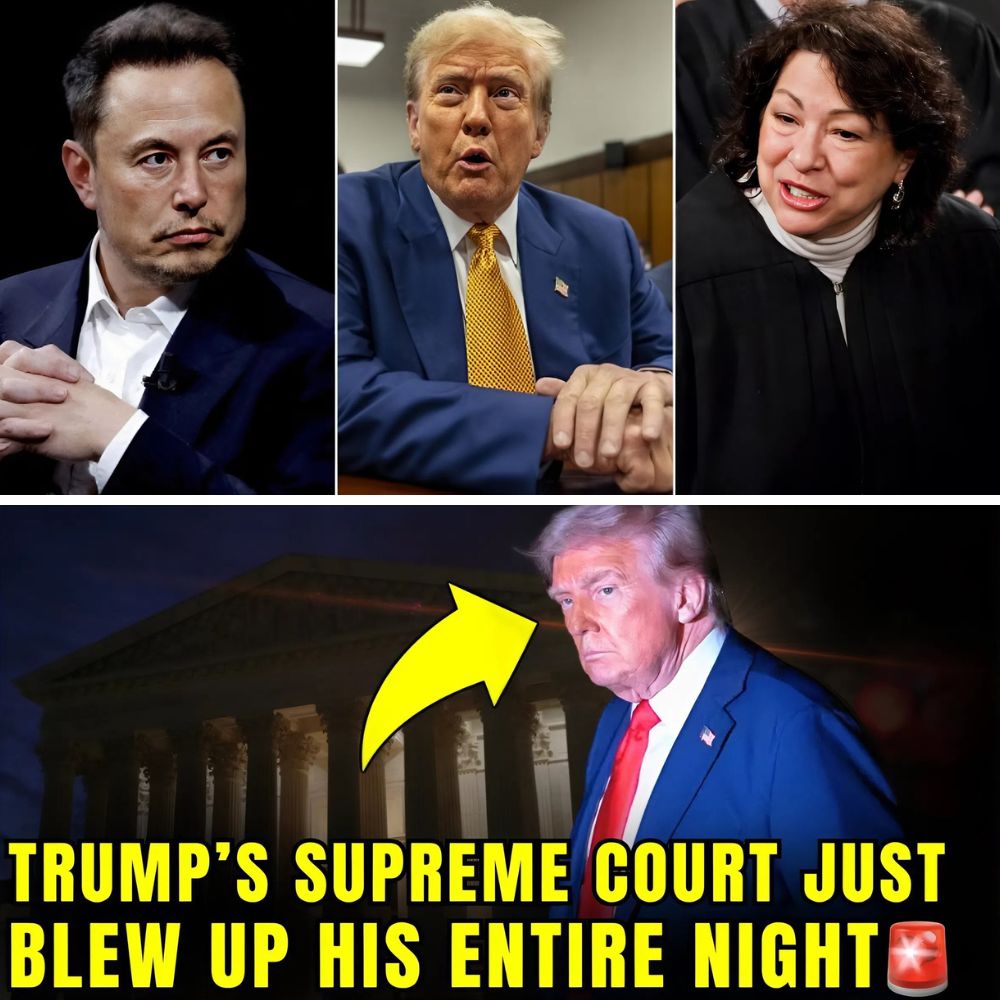
Supreme Court Signals Deep Unease Over Modern Campaign Finance as Justices Confront Trump-Era Donor Influence
WASHINGTON — In a rare, unguarded exchange during Supreme Court arguments this week, Justice Sonia Sotomayor delivered one of the most pointed critiques in years of the nation’s campaign finance system, questioning whether decades of deregulation had enabled a political environment in which wealthy donors wield disproportionate influence — and in some cases, appear to exercise unchecked access to the highest levels of government.
The comments came as the Court considered a challenge brought by the National Republican Senatorial Committee against the Federal Election Commission. The case targets long-standing limits on coordinated spending between candidates and political parties, a framework designed to prevent quid pro quo corruption. Republican plaintiffs contend such limits violate the First Amendment by restricting political expression.
But what transpired inside the chamber suggested that at least some justices believe the country has already drifted far from a functioning system of safeguards.
A System Under Strain
At the heart of the argument was a broader question: in the post–Citizens United era, has the United States crossed a threshold in which money has become so central to political power that democratic institutions struggle to maintain credibility?
Justice Sotomayor, invoking recent examples across both parties, pressed attorneys to address whether the current legal structure meaningfully prevents corruption. She cited blockbuster fundraising entities — the joint finance committees that allow donors to bundle contributions across national and state party organizations — noting that single individuals had written checks worth hundreds of thousands of dollars.
By 2024, donation caps to some committees had climbed above $800,000. Similar structures used by Democrats topped $1 billion during the 2020 cycle.
“What is left?” Justice Sotomayor asked. “If we eliminate the remaining coordinated spending limits, what remaining mechanisms prevent influence from becoming indistinguishable from purchase?”
Her comments drew on prominent recent examples, including Elon Musk’s role as one of Donald Trump’s largest political patrons during the last election cycle. Musk, who donated hundreds of millions of dollars to pro-Trump efforts before parting with the campaign following public disagreements, later received significant attention from the administration amid major federal contracting opportunities.
While the Court was careful to avoid specific factual determinations, the mere invocation of the relationship during oral arguments underscored how central donor influence has become to public debate.
A Political Environment Shaped by Wealth
The Court’s 2010 Citizens United ruling dramatically reshaped campaign finance, allowing unlimited independent expenditures by corporations and wealthy individuals. Subsequent decisions further eased restrictions on contribution limits, effectively creating a political ecosystem in which megadonors exert unprecedented pressure on policymaking.
Legal experts say the result is a system in which candidates increasingly depend on a narrow group of donors for viability — a dynamic that critics argue encourages access, favoritism, and policy alignment that skirts, or at times openly challenges, the intent of anti-corruption laws.
In the current case, Republican Senate campaign officials claim the FEC’s coordinated spending caps hinder political parties from effectively supporting their own nominees. But critics warn that eliminating those limits would largely erase the boundary between independent expenditures and direct support, giving wealthy donors broad new avenues for influence.
“You are telling us that every time we adjust the system, we make things worse,” Justice Sotomayor said, questioning whether decades of judiciary-driven deregulation had fractured campaign finance so profoundly that Congress no longer possessed the tools to curb the most extreme abuses.
Examples of Influence Under Scrutiny
During the exchange, Justice Sotomayor highlighted instances across three administrations — examples intended to illustrate not partisanship, but structural vulnerability.
She pointed to reports suggesting that large donors to both Donald Trump and Joe Biden later secured access, appointments, or favorable regulatory consideration. While the Court historically distinguishes access from corruption, Sotomayor pressed attorneys on whether the public perceives that distinction when the scale of donations approaches millions.
One of the central hypotheticals referenced a large donor allegedly receiving a “lucrative government position” following a new administration’s inauguration. Though the attorney for the NRSC disputed the characterization, Sotomayor countered that the larger issue was not salary but government contracts — and the public’s perception of reciprocity.
“It may not be quid pro quo bribery,” she said, “but it certainly raises the appearance of it.”
A Rare Flash of Frustration Inside the Court
Such direct language — referencing specific political examples and citing individual donors by implication — is uncommon at the Court, whose members typically guard their neutrality carefully. But the tenor of the hearing reflected a growing recognition that Americans’ trust in elections remains fragile.
Political scientists note that the rise of prominent donors, including technology leaders, hedge fund owners, and foreign-aligned investment groups, has fueled concern that U.S. policy can be influenced in ways that bypass institutional guardrails.
Recent controversies — including reports of foreign investment routed through opaque political entities during past campaigns — have amplified those anxieties. While no one example is determinative, the accumulation has created an environment of heightened skepticism.
Implications for the 2024 and 2028 Elections
Depending on how the Court rules, the consequences could be far-reaching. A decision in favor of the NRSC may open the door for dramatically expanded coordination between campaigns and national political parties, effectively increasing the amount a wealthy donor could give to support a single candidate.
Reform advocates warn that such a shift would accelerate a trend in which electoral power becomes increasingly concentrated. Party strategists counter that the change would strengthen national parties relative to super PACs, which currently operate with fewer transparency requirements.
Either outcome carries significant implications for the 2024 general election cycle and beyond, where early fundraising suggests the cost of national campaigns will surpass all previous records.
A Debate Far From Resolved
For now, the Court’s ultimate direction remains unclear. Several conservative justices signaled skepticism toward maintaining limits on coordinated spending, suggesting they view such caps as outdated under modern political realities. Others questioned whether Congress, not the judiciary, is better positioned to address concerns about undue influence.
Yet the forcefulness of Justice Sotomayor’s remarks left an imprint, highlighting how deeply intertwined money, political access, and public trust have become in contemporary governance.
In a political landscape increasingly defined by large-scale donations, overseas funding scandals, and high-profile donor relationships, the Court’s decision could determine whether campaign finance becomes more regulated, or whether the trend of deregulation continues — reshaping American democracy in ways voters may feel but not yet fully see.