

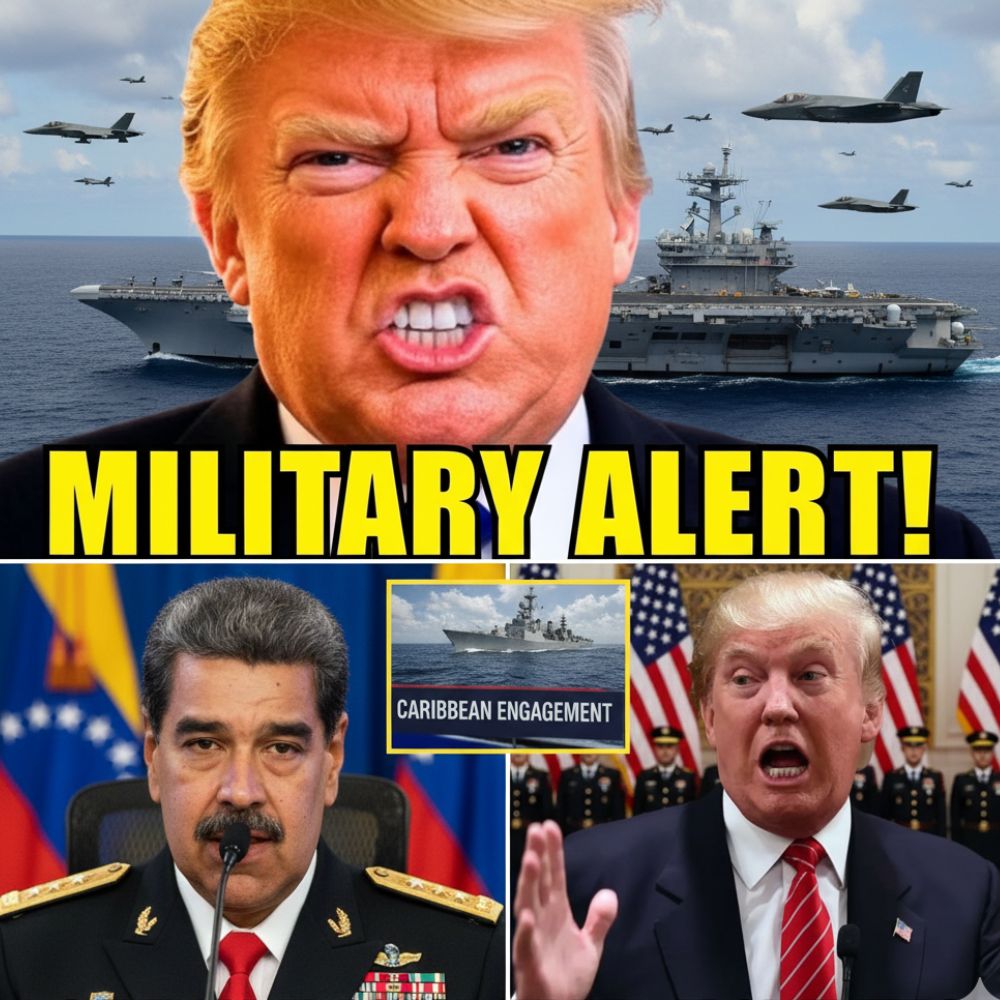
U.S. SEIZURE OF VENEZUELAN OIL TANKER IGNITES DIPLOMATIC FIRESTORM AS TRUMP SHRUGS OFF PIRACY CLAIMS
In a dramatic escalation that has jolted Western Hemisphere politics and revived long-simmering debates over American interventionism, the United States’ lightning seizure of a Venezuelan-linked oil tanker has triggered a wave of international condemnation, internal legal scrutiny, and renewed fears of a dangerous geopolitical spiral.
At the center of the storm is former President Trump, who has responded to accusations of “bare-faced robbery” with characteristic bravado — insisting the U.S. acted “for a very good reason” while openly admitting he has no clear answer on what will happen to the oil itself.
A High-Risk Operation, A Shrug From Trump
The tanker — identified by officials as the Skipper — was intercepted off the Venezuelan coast in a joint operation involving the U.S. Coast Guard, FBI, Homeland Security, and elements of the Department of Defense. Dramatic footage posted online by Attorney General Pam Bondi shows armed U.S. personnel rappelling from a helicopter onto the ship’s deck, a level of force that surprised even longtime observers of sanctions enforcement.
According to early reporting from U.S. officials, there was no resistance from the ship’s crew and no casualties. But the political shockwaves have been considerable.
Venezuela swiftly denounced the operation as “international piracy,” and its president, Nicolás Maduro, mocked the U.S. response by singing Don’t Worry, Be Happy at a rally. But beneath the theatrics lies a deeper and more volatile confrontation between Washington and Caracas — one that analysts fear could widen in unpredictable ways.
When asked what the U.S. intends to do with the thousands of barrels of crude now under American control, Trump offered an answer both flippant and revealing:
“Well, we keep it, I guess.”
The remark has already ricocheted across diplomatic circles. Even in a region long familiar with U.S. intervention, few expected a sitting president — or former president looming over a re-election landscape — to casually acknowledge the seizure of foreign property in such blunt terms.
Pressure on Maduro — and Risks for Washington
Experts say the tanker operation is only the latest escalation in a pressure campaign aimed at destabilizing or ousting President Maduro. What remains unclear is whether the U.S. has a cohesive strategy — or whether Trump is improvising actions that could trigger strong backlash.
Richard Haass, president emeritus of the Council on Foreign Relations, warned that such moves risk inflaming anti-American sentiment across Latin America, even among governments critical of Maduro.
“Even people who want to see Maduro go do not want this kind of heavy-handedness,” Haass said. “This will be welcomed in Moscow and Beijing, not Bogotá or Brasília.”
The fear, several analysts stressed, is not just diplomatic isolation — but the possibility that the increasingly aggressive maritime operations could ignite a broader conflict. Senator Rand Paul compared the tanker seizure to “the beginning of a war,” a sentiment echoed by others alarmed at the growing number of interdictions and maritime strikes reported in recent weeks.
A Legal and Moral Minefield
Beyond geopolitics lies a profound legal dilemma. While the Skipper had been sanctioned years earlier for allegedly participating in an illicit oil-shipping network linked to Iran, critics argue the U.S. crossed a line by physically commandeering the vessel.
One commentator — reflecting a view voiced more frequently in academic and international law circles — noted that if another nation seized U.S. assets abroad in similar fashion, Washington would treat it as an outrageous violation of sovereignty.
“Fundamentally, the U.S. is doing something it would never tolerate being done to itself,” he argued, pointing out that seizing property tied to a political opponent sets a precedent that could easily backfire in the global arena.
Still, within the U.S. government, officials maintain the seizure was lawful and necessary. They emphasize that unlike other recent maritime confrontations — several of which resulted in more than 80 deaths during anti-drug operations — this mission involved no lethal force and adhered to Coast Guard protocols.
Uncertain Endgame
As the dust settles, diplomats and analysts alike are left asking the same questions:
What exactly is the United States trying to achieve?
And how far is Trump willing to go?
The administration has sent mixed signals — publicly emphasizing drug-interdiction goals while privately signaling a desire to tighten Maduro’s financial stranglehold. Yet the tanker seizure, the saber-rattling toward Colombia’s leadership, and the release of dramatic operational footage all point to a White House eager to project power, even at the risk of regional backlash.
In the streets of Caracas, in Washington think tanks, and across foreign ministries worldwide, the debate now centers on whether this is simply another chapter in America’s long history of intervention — or the opening scene of a far more dangerous geopolitical drama.
Either way, the world is watching — and online, the reactions are multiplying at breakneck speed as the internet explodes.