

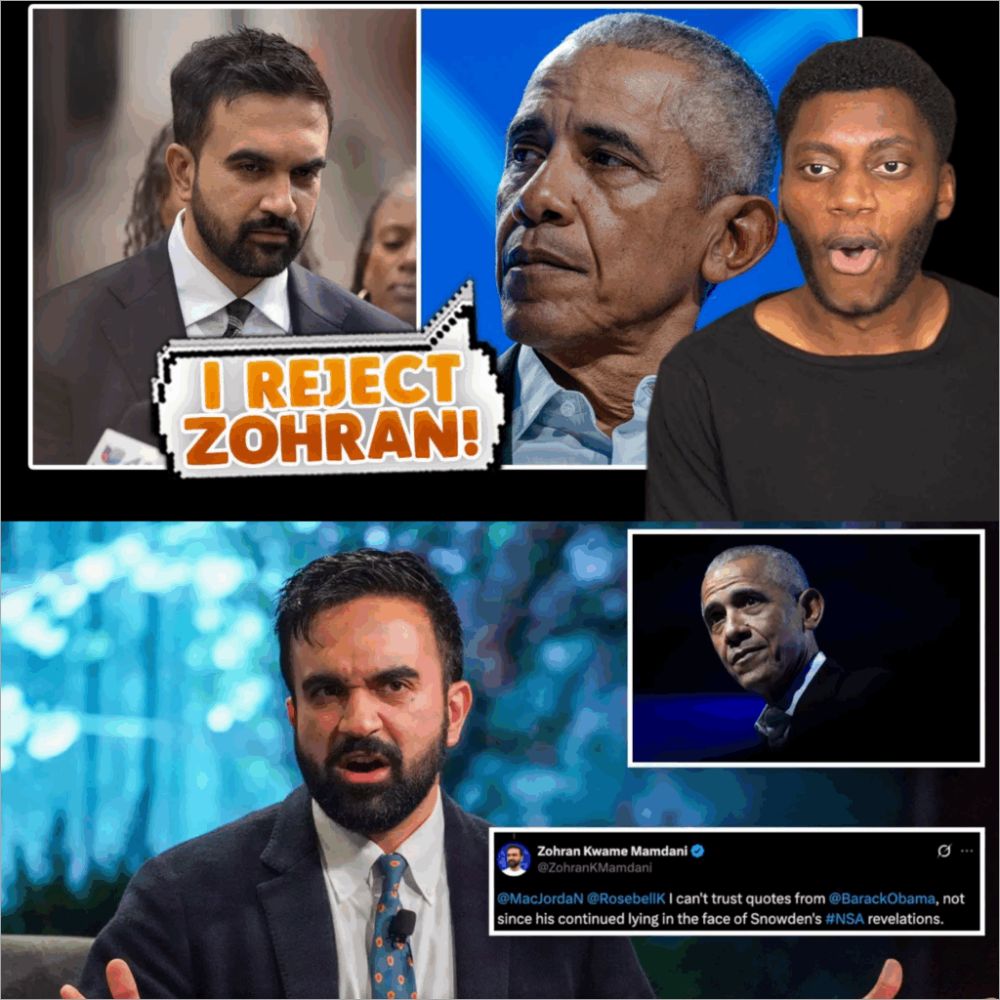
What Obama Just Did May Have Just TOPPLED Mamdani…
The Democratic Party, often portrayed as a unified front, is frequently navigating complex ideological tensions. These internal conflicts came into sharp focus following the revelation that former President Barack Obama withheld an endorsement for progressive mayoral candidate Zohran Mamdani, the frontrunner in a contentious New York City local race. This decision has been widely interpreted by political commentators as a deliberate strategic move, highlighting a brewing “civil war” between the party’s mainstream establishment and its powerful, activist progressive wing.
The Endorsement Dilemma: A Breach of Precedent
The immediate controversy stems from Obama’s refusal to back Mamdani, despite the candidate’s strong polling position. Critics argue that this non-endorsement is highly significant and hypocritical, directly challenging the campaign’s attempt to secure broad party validation.
Mamdani’s campaign adviser attempted to downplay the omission by claiming a “long-standing rule post-presidency” that Obama does not endorse in local races. However, the commentary quickly dismantled this defense by citing numerous instances where Obama has endorsed candidates across various levels of local government:
Mayoral Races: Obama previously endorsed Bill de Blasio (NYC), Karen Bass and Eric Garcetti (Los Angeles), and Rahm Emanuel (Chicago), among others, contradicting the notion of a firm rule.
Hyper-Local Races: Endorsements have been made in races as local as City Council (Sophia King, Chicago) and School Board (San Francisco and Richmond, Virginia), demonstrating a history of wading into hyper-local politics when deemed necessary.
The refusal to endorse Mamdani, therefore, is viewed not as adherence to a rule, but as a deliberate political signal, withholding the institutional legitimacy that Obama’s stamp of approval carries.
The Frankenstein Analogy: Creator vs. Creation
A central theme in the commentary is the idea that Obama views the progressive wing, represented by figures like Mamdani, AOC, and Bernie Sanders, as a “Frankenstein’s monster” that he inadvertently helped create and now fears.
The argument posits that the progressive movement, which often champions policies like government-owned grocery stores and rent freezes, is a radicalized extension of the political outsider narrative that Obama himself popularized. The key points of comparison include:
Outsider Status: Both Obama and Mamdani are presented as having entered politics as outsiders, challenging the existing structure.
Rapid Ascent: The commentary claims the development of Mamdani’s politics is a consequence of the path Obama carved, suggesting “Obama walked so Zohran could run.”
The resulting tension is that the establishment (Obama, Schumer, Pelosi) recognizes the electoral danger of these policies on a national scale. While Mamdani’s platform may be popular within a “blue bubble” like New York City, national candidates running on such radical platforms in swing states like Arizona would face immediate backlash. Therefore, withholding the endorsement is interpreted as an act of political self-preservation—the establishment attempting to distance the national Democratic brand from the progressive faction’s potentially “destructive policies.”
A Brewing Civil War
The lack of enthusiasm for Mamdani from other establishment figures further supports the civil war narrative:
Chuck Schumer and Kirsten Gillibrand declined to endorse anyone.
Hakeem Jeffries waited until the day before early voting began to publicly back Mamdani.
Tom Suozzi, a moderate Democrat, chose to back former Governor Andrew Cuomo.
This collective avoidance suggests that mainstream Democrats believe the progressive wing has become a major electoral liability. The fear is that if a progressive candidate like Mamdani wins and implements policies that lead to a dramatic decline in the city, the entire Democratic Party will be blamed. This would provide “free campaign material for Republicans,” who could easily use New York’s struggles as a national warning against Democratic governance.
In this context, the party’s elite are seen as engaging in sleepless nights, not over policy, but over how to regain control of their party from the radicalized elements that have effectively hijacked it. The non-endorsement of Mamdani is not an attack on an individual, but a surgical maneuver in a long-term fight to protect the national viability of the Democratic Party against its most ideological base.