

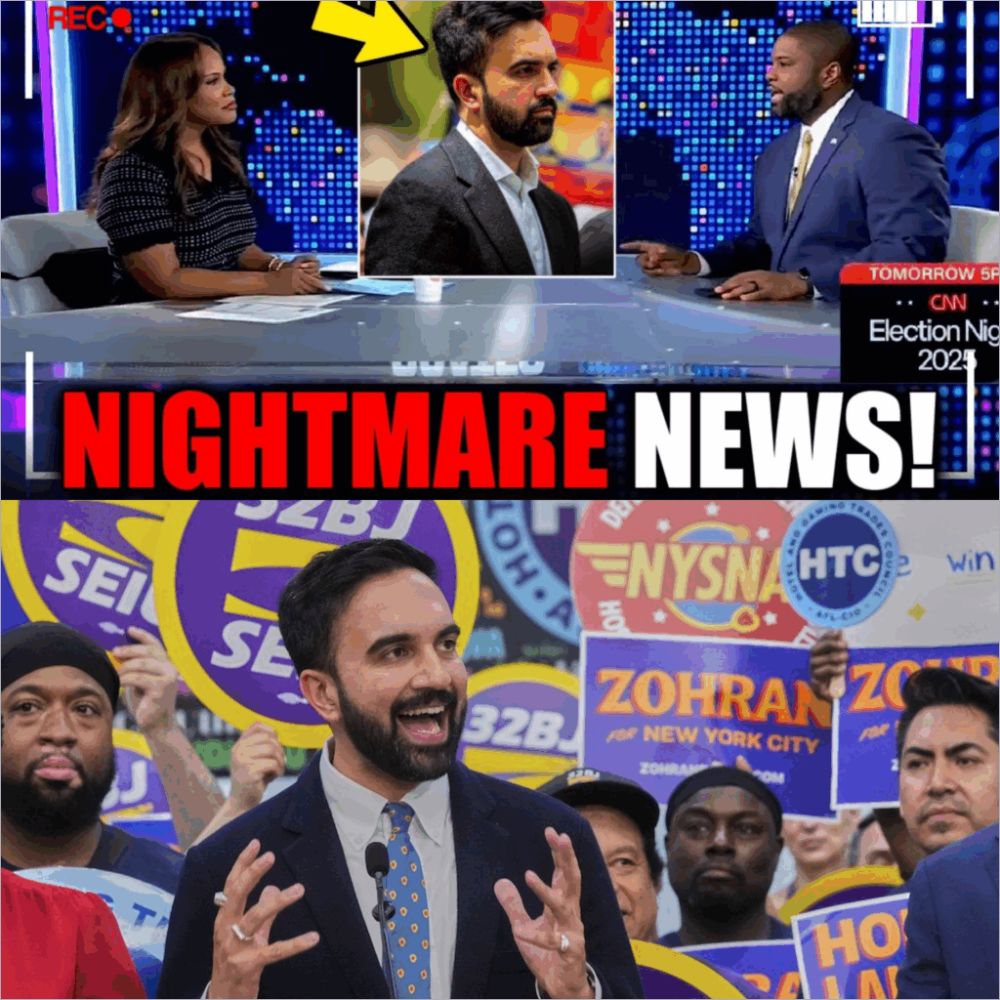
Mamdani Gets FATAL BLOW After Byron Donalds GOES SCORCHED EARTH on CNN
Political Theater or Economic Reality? Byron Donalds Goes “Scorched Earth” on CNN Over Progressive Policies
A recent debate on CNN featuring Representative Byron Donalds (R-FL) escalated rapidly into a “scorched earth” confrontation as Donalds fiercely attacked progressive political policies and rhetoric, primarily targeting New York politician Zohran Mamdani and the broader political left. Donalds’ approach was highly aggressive, characterized by accusations that Mamdani and his allies promote “communist” policies that are fundamentally unsustainable and economically disastrous.
The segment became a sharp exchange on the differences between socialism and communism, the practical viability of “free” government services, and the perceived hypocrisy of Democratic leaders regarding political dissent.
The Central Target: Zohran Mamdani and “Communist” Policies
Representative Donalds initiated his attack by labeling Mamdani’s proposals as “communist,” a term his debate opponent immediately challenged as a “trigger word” meant to undermine policies through fear.
Donalds’ Accusation: Donalds stated bluntly, “What’s wrong with you people when you put in communist and yes communist policies? That’s what Zohran Mamdani is talking about.” (0:53–1:00).
The Defense: The opponent argued, “He’s not a communist, socialist. He says he’s a democrat… The socialism is not the same basis of communism in this country. You know that quite well.” (1:01–1:11).
Donalds’ Dismissal: Donalds dismissed this distinction, stating, “I can’t tell what the difference is.” (1:04) and asserting that he didn’t need to undermine the policies because “his policies undermine himself because they’ve never worked.” (1:25–1:29).
Donalds focused on two specific proposals championed by Mamdani and the progressive wing: “government-run grocery stores” and “free transportation” (1:14–1:16).
The Economic Reality Check: “No Free Lunch”
Donalds argued that these promises of “free” services are economically impossible and lead to systemic failure.
The Cost of “Free”: He challenged the notion of a “free bus” by asking rhetorically what happens when a service is supposedly free: “There’s nobody there to fix it or to drive it. He knows that. I know that. You know that.” (1:45–1:49). This assertion is designed to highlight the hidden costs and degradation of public services under socialist models, a core tenet of conservative economic criticism.
Inflation and Groceries: The debate briefly shifted to the issue of inflation, which Donalds argued is directly impacting Americans’ quality of life. The opponent attempted to claim the cost of gas was low, but Donalds quickly pivoted to the cost of groceries, specifically eggs, implying that economic hardship is universally felt. “$8.99 for eggs is not low,” (2:12–2:25) he emphasized, using a tangible example to underscore the pain of inflation under current economic conditions.
Donalds’ overarching message was direct: “There is no free lunch just like there’s no free bus.” (1:41–1:43).
The Political Hypocrisy: Defining “King” Trump
The second major point of conflict involved the rhetoric used by the left to criticize former President Donald Trump, who was often compared to a “king” or a “dictator.” Donalds flipped this comparison on its head by contrasting Trump’s actions (or lack thereof) with the hypothetical actions of an actual dictator.
The opponent claimed, “Trump does think that he’s a king. And he thinks that he can act more corruptly when the government is shut down.” (2:51–2:56).
Donalds systematically countered this narrative by defining what a true “king” or “tyrant” would actually do, ironically contrasting those tyrannical actions with policies enacted by others:
Control over the State: Donalds argued that if Trump were truly a king, “the government would be open right now.” (3:00–3:04).
Suppression of Rights: A king “wouldn’t be allowed to have your protest against him,” nor would he allow “freedom of religion,” or freedom of speech on “social media platforms” (3:06–3:20).
Government Overreach: Donalds culminated his argument by pointing out that a king would mandate what businesses were allowed to be open and “force you to take an experimental [vaccine]” (3:27–3:36), a clear and direct critique aimed at the public health measures implemented by the opposing administration.
Donalds ended the segment on this point, leaving the implication that the left’s definition of “tyranny” is selective and ignores actions taken by those they support.
Conclusion
Representative Byron Donalds’ aggressive approach achieved its objective: to frame progressive policies as economically unviable and ideologically extreme. By refusing to engage in academic distinctions between socialism and communism, and by using the “king” analogy to highlight perceived hypocrisy regarding political freedoms and government control, Donalds delivered a direct challenge to the progressive platform.
The segment underscores the widening gulf in American politics, where debates over economic theory and political labels are fought with high-stakes rhetorical warfare designed to define the opponent as antithetical to American success.